A source-informed practical guide. Examples explain decisions and arithmetic; they are not claims of a kitchen trial by this publication.
A pan substitution changes both capacity and the distance heat must travel through the batter. For straight-sided round and rectangular pans, comparing total base area gives a useful first estimate when you want approximately the same batter depth. It does not calculate exact baking time, and it does not apply directly to a fluted, tube or strongly tapered pan.
Measure the working space
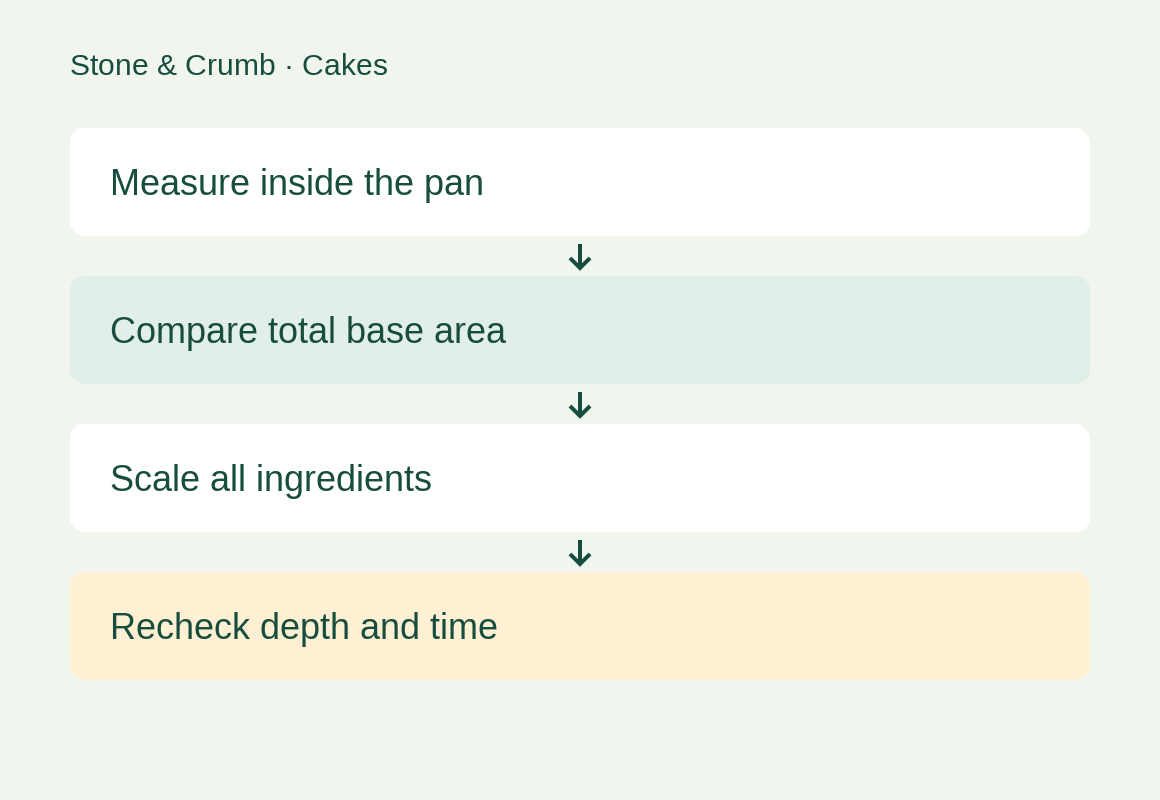
Measure inside the pan, using the same unit for both the original and replacement. For a round pan record diameter, not radius. For a rectangle record length and width. Include how many pans the original recipe fills and how many replacement pans you will use. Two small pans cannot be compared with one large pan by diameter alone.
Check usable depth and the recipe's required headroom separately. An area calculation assumes similar batter depth, not permission to fill a shallow tin to the rim. When the shape is irregular or capacity is uncertain, use a recipe specifically tested for that pan.
Work through the ratio
For an illustrative single round pan changing from 20 cm to 24 cm, the area ratio is 24 squared divided by 20 squared, or 1.44. Multiply each ingredient by 1.44 to target a similar starting depth. A 200 g flour quantity becomes 288 g. This example describes geometry, not a cake formula.
If the original recipe fills two 20 cm pans and you want one 24 cm pan, the ratio is 1.44 divided by two, or 0.72. Forgetting pan count would make twice the intended amount. Use the pan converter and then enter its factor into the recipe scaler.
Reassess the bake
Keep pan material and oven mode as close to the tested recipe as possible. Even at similar depth, a wider pan changes the balance of centre and edge. Start from the recipe's temperature and inspect its doneness cues; do not multiply baking minutes by the area factor.
If you retain the original batter amount in the larger pan, expect a shallower layer and potentially earlier completion. If you place it in a smaller pan, avoid overfilling; reserve excess for a suitable separate bake only if the recipe supports that approach.
Leave a record for next time
Write the measured dimensions, pan count, scaling factor, batter mass per pan and actual finishing time beside the recipe. Those notes turn one successful substitution into a usable version. An estimated ratio becomes dependable kitchen knowledge only after the actual formula, pan and oven have been checked together.