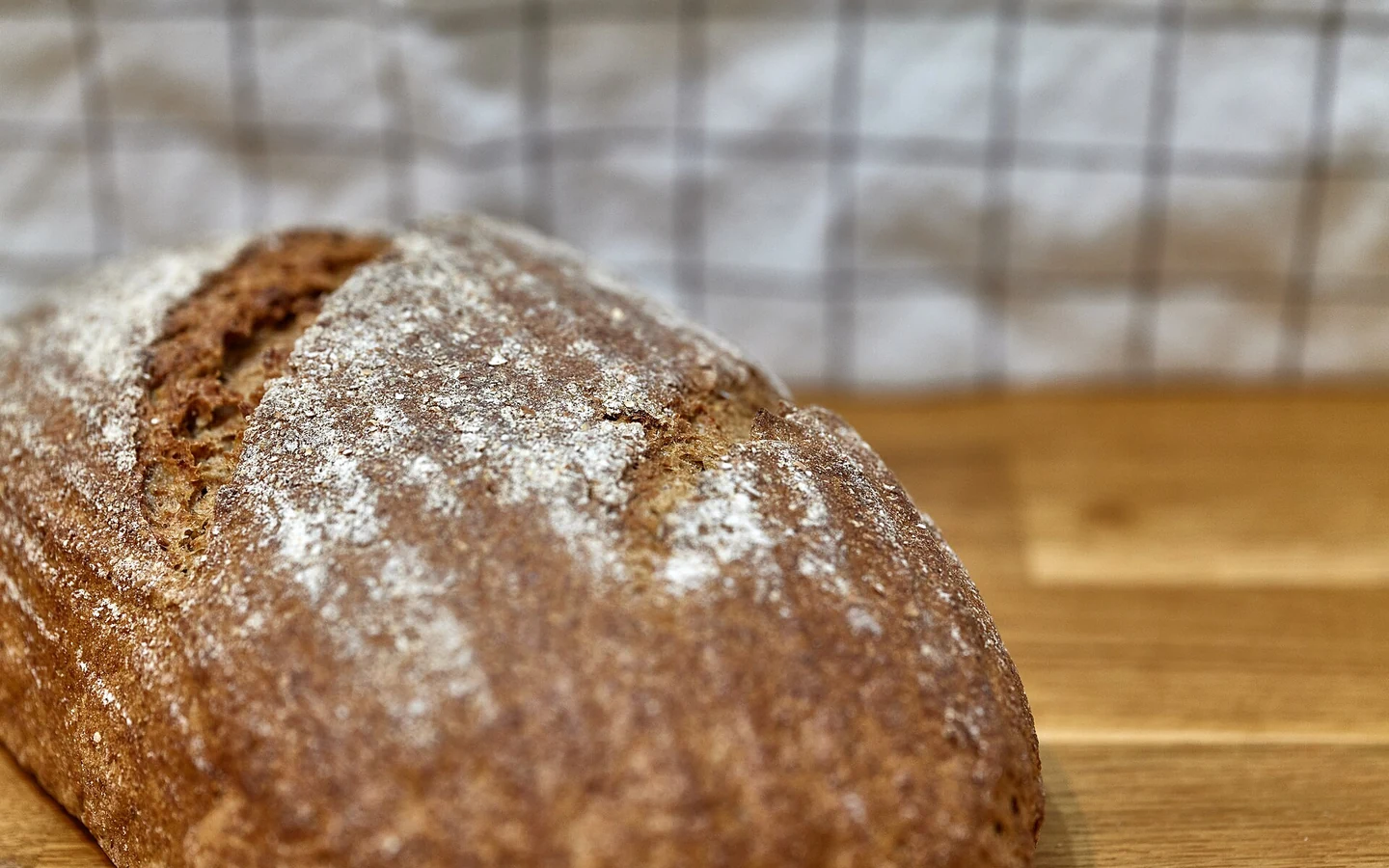
Buy a loaf in Germany and the name on the label is doing more work than it appears to. Roggenbrot, Roggenmischbrot, Weizenmischbrot, Roggenschrotbrot and Roggenvollkornbrot are not stylistic labels chosen by the bakery. Each corresponds to a flour composition set out in a published national text, and moving a few percentage points changes which name a baker is allowed to use.
What the guidelines are
The text is the Leitsätze für Brot und Kleingebäck, part of the Deutsches Lebensmittelbuch. The current version was newly issued on 1 April 2021 and last amended by a notice of 22 January 2026. It is not a criminal statute; it describes what the trade and consumers legitimately expect a given designation to mean, which is what makes departures from it actionable as misleading labelling.
Its definition of bread is broad. Bread is a food made from cereals or cereal products, with water or water-containing liquid and other foods added, produced as a rule by kneading, forming, leavening and baking, or by cooking extrusion of the dough. One numeric limit sits in that definition: taken together, added fat and sugar do not as a rule exceed 10 per cent, calculated on the cereal component. Above that, a product drifts out of bread and into pastry territory.
Products carrying a protected designation of origin or protected geographical indication are explicitly set outside the naming section, since they answer to their own specifications.
Naming a bread after one grain
If a single bread cereal appears in the name, that cereal must supply at least 90 per cent of the cereal content, and it must be used only in flour form. This is what stands behind Weizenbrot, Roggenbrot, Dinkelbrot and Emmerbrot. Weißbrot follows the same rules as Weizenbrot.
The Deutsches Brotinstitut, which named Roggenbrot its bread of the year for 2026, states the rye case plainly: under the guidelines, Roggenbrot must consist of at least 90 per cent rye flour, while the recipe, shaping and baking process are left to the baker.
There is one worked exception. Roggenbrötchen, rye rolls, are permitted a lower rye share for baking-technology reasons connected to crumb texture, alveolation and volume, but the rye proportion must still exceed 50 per cent. Grains and pseudocereals outside the core bread-cereal group are treated more loosely: Haferbrot, Maisbrot, Hirsebrot and Amaranthbrot require at least 20 per cent of the named grain.
How a Mischbrot is named
The mixed breads are where the thresholds become interesting, and where a common misreading circulates.
Used on its own, Mischbrot means wheat and rye each contributing 50 per cent, both in flour form. When a cereal name is combined with Mischbrot or Mischbrötchen, two conditions apply at once: the named cereal must supply more than 50 per cent in flour form, and the other bread cereal must supply more than 10 per cent, also in flour form. That construction governs Weizenmischbrot, Roggenmischbrot, Dinkelmischbrot and Emmermischbrot.
Where the thresholds bite
So a Roggenmischbrot is more than half rye flour with at least a tenth wheat flour, and a Weizenmischbrot is the mirror image. A loaf that is 92 per cent rye is no longer a Roggenmischbrot; it has crossed into Roggenbrot. A loaf that is 55 per cent rye and 8 per cent wheat fits neither construction cleanly.
It is worth noting what the current text does not say. Secondary accounts frequently render these rules as a band, something like 51 to 89 per cent. The guidelines as they stand express them as inequalities: more than 50 per cent of the named cereal, more than 10 per cent of the other. The practical outcome overlaps, but the wording is the wording, and it is the wording that a labelling dispute would turn on.
Two further families follow the same logic. For Schrotbrot, made with coarsely broken grain rather than flour, at least 90 per cent of the cereal must be Schrot, and the grain has to be identified, giving Roggenschrotbrot, Weizenschrotbrot or Dinkelschrotbrot; blends are named by the same ordering rule, hence Weizenroggenschrotbrot or Roggenweizenschrotbrot depending on which dominates. A loaf that merely advertises a Schrot component needs at least 10 per cent.
For Vollkornbrot, at least 90 per cent of the cereal must be present as whole grain. And here the guidelines add a clause about acid: if acid is added, at least two thirds of it must come from sourdough. A wholemeal loaf may be acidified, but not predominantly by tipping in a bought acidulant.
Why rye has to be soured at all
That two-thirds clause is not arbitrary. Rye behaves differently from wheat in the dough, and the difference is enzymatic rather than a matter of taste.
The Brotinstitut puts the mechanism in one sentence: only through sourdough management are the enzymes regulated, and only then can rye flour be baked at all. Rye's starch-degrading enzyme activity, if left unchecked, breaks down the starch that is supposed to set into a crumb, and the loaf collapses into something gummy. Lowering the pH through a sour fermentation brings that activity under control. Sourdough is not an optional flavour choice in a rye loaf the way it is in a wheat loaf; it is the condition under which the loaf holds together. Flavour, keeping quality and digestibility come along as consequences.
This is why so many named German rye breads are also sour breads, and why the regional examples the institute lists, Westfälisches Pumpernickel, Hamburger Schwarzbrot, Ammerländer Vollkornbrot and Rheinisches Schwarzbrot, are all built on long acidification rather than yeast alone.
What the register of names means
Around this framework sits an unusual amount of institutional record-keeping. The Deutsches Brotinstitut, a registered association descended from a bread inspection and advisory service set up by the German baking trade in the 1950s, maintains the Deutsches Brotregister, which currently lists more than 3,000 distinct bread varieties baked and sold in Germany. The institute carries out roughly 15,000 sensory quality inspections a year in the craft baking trade, publishes positive results as consumer guidance, and is supported by a scientific advisory board of five cereal researchers and nutrition scientists. It is registered in Berlin with an office at the baking trade's academy in Weinheim, and it credits more than 8,900 craft bakeries with maintaining this range. German bread culture is recognised by the German UNESCO commission as intangible cultural heritage.
Reading the label
Put the two halves together and a German bread label becomes readable in a way most are not. The name tells you the flour composition within a few percentage points. If the name contains Vollkorn, at least nine tenths of the cereal is whole grain and any acidity is mostly fermented rather than dosed. If the name leads with Roggen, rye dominates, which in turn means the dough was almost certainly soured, because otherwise it could not have been baked.
What the name does not tell you is how long that souring ran, at what temperature, or how skilfully. Those are the questions worth asking at the counter, precisely because they are the ones the guidelines leave open.