A source-informed practical guide. Examples explain decisions and arithmetic; they are not claims of a kitchen trial by this publication.
When one side burns while the other stays pale, a recipe change is not the first investigation. Oven mode, shelf position, crowding and bakeware can all change the heat reaching the food. Start with a simple record of the setup. The display temperature alone does not describe how every part of the oven bakes.
Establish a repeatable starting point
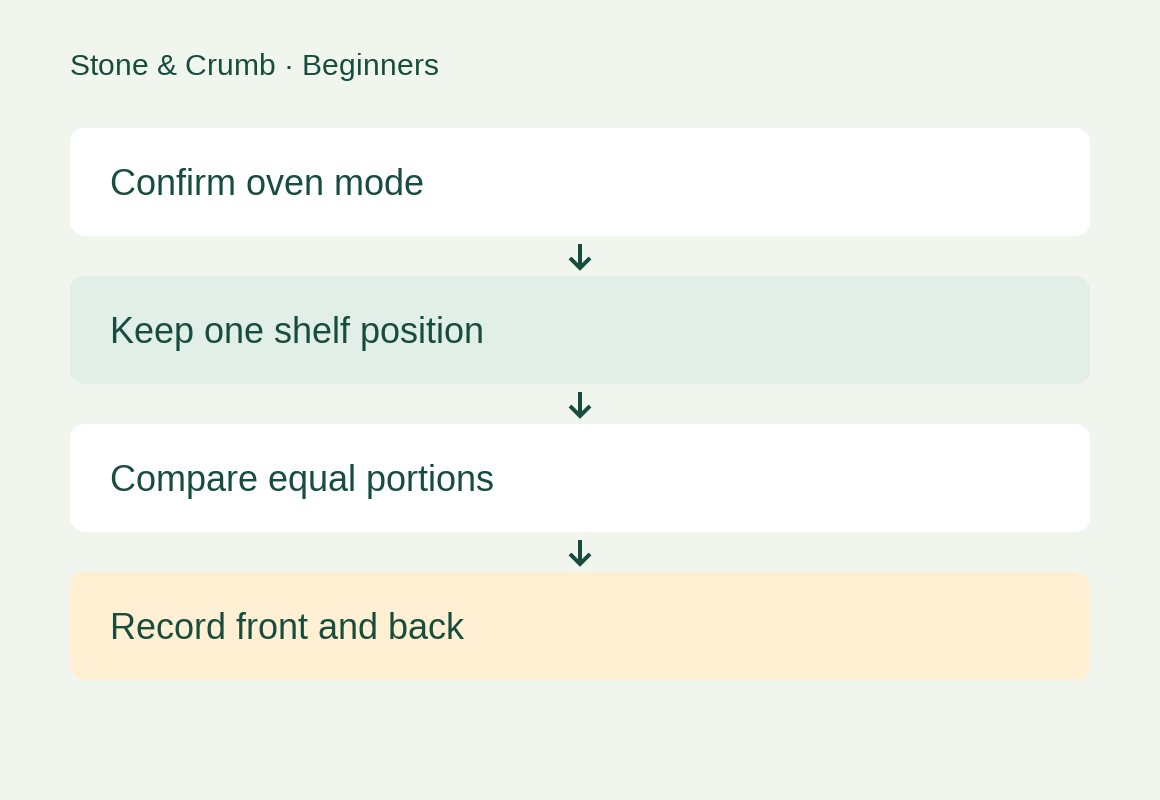
Check whether the recipe expects a conventional or fan oven. Use the oven manual for mode-specific guidance rather than applying an automatic conversion to every recipe. Arrange the shelf before preheating. Unless the recipe says otherwise, begin with enough clearance around the pan for air circulation and avoid crowding the cavity with unused trays.
Allow the oven to preheat according to its instructions. A beep does not measure the stored heat in every wall or baking surface. If you use an oven thermometer, observe it over a heating cycle instead of treating one reading as the cavity's permanent temperature. Keep it away from direct contact with a wall or element.
Use equal portions as a diagnostic
On your next cookie batch, place equal-weight portions with similar spacing on one tray. Sketch their positions before baking. After cooling, compare the front, back, left and right. This is a practical observation of that batch, not a calibrated temperature map. Different thicknesses or uneven portion sizes would confuse the comparison.
If one area repeatedly browns faster, plan a rotation at a suitable point in future bakes. Avoid opening a delicate cake repeatedly before its structure has set. Use the recipe's guidance and observe through the door where possible. A cookie test tells you where to investigate; it does not justify moving every cake halfway through its rise.
Separate pan effects from oven effects
Changing from a pale metal sheet to a dark one may alter the underside even at the same setting. Glass, ceramic and metal also transfer heat differently. Keep the recipe's specified material when learning its behaviour. If you must change pans, record both dimensions and material, and watch the bake rather than promising the same finishing time.
Check that a pan is sitting level. Uneven batter depth can make one side appear underbaked even when the oven is reasonably consistent. Do not line the oven floor with foil or add an improvised heat shield without checking the manufacturer's instructions.
Choose the next adjustment
If the base burns across the tray, investigate shelf position and pan material. If only the rear portions brown rapidly, investigate distribution and a suitable rotation. If everything takes longer than expected, verify mode, preheating and actual cycling behaviour before adding leavener.
Keep one change per comparison so you can identify what helped. The troubleshooting tool links symptoms to checks, while the pan converter helps when the batter depth changed. Neither tool measures your oven, so your recorded setup remains essential.