A source-informed practical guide. Examples explain decisions and arithmetic; they are not claims of a kitchen trial by this publication.
When a recipe provides grams, use those weights throughout the batch. A cup is a volume, and flour can occupy that volume loosely or tightly. Switching between a recipe's gram column and a different conversion chart can quietly change the formula. The most useful measurement system is one that stays consistent from start to finish.
Weigh without losing your place
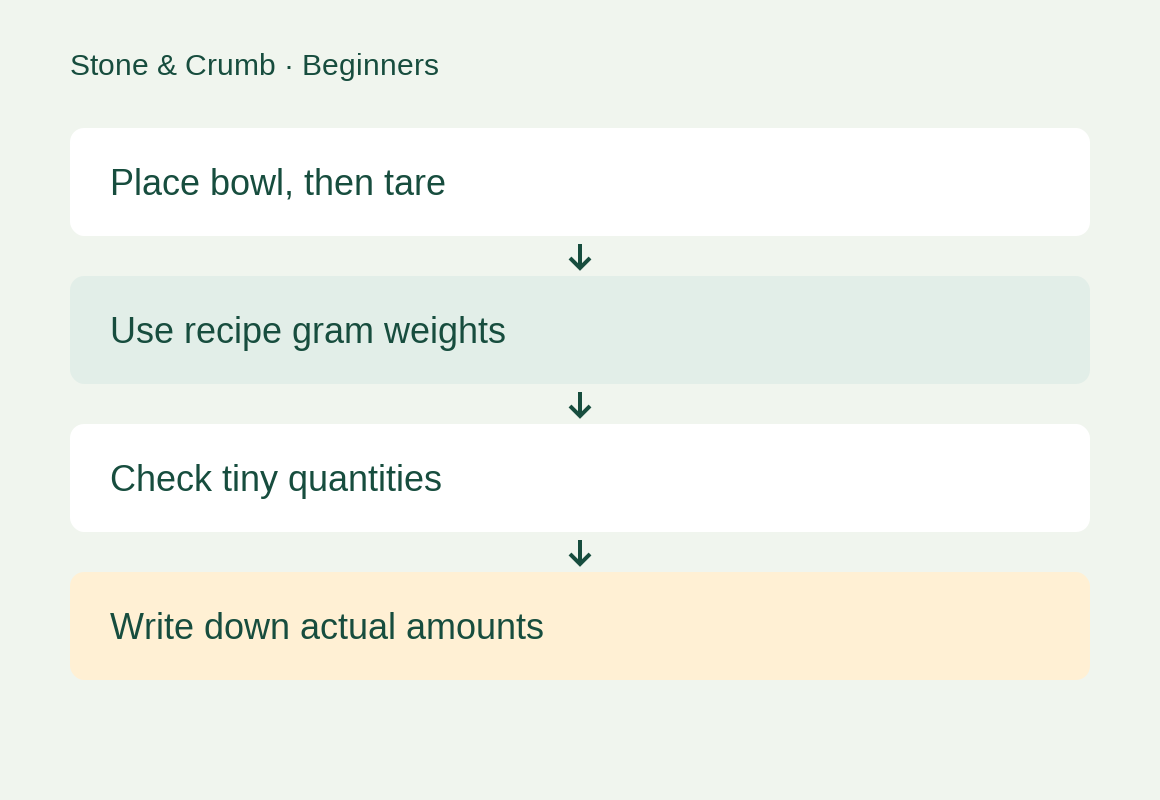
Place the scale on a firm, level counter. Choose grams, put the empty bowl on it and tare. Add the first ingredient slowly as you approach the target. Keep a written tick beside the completed ingredient before taring again. If the display switches off while you fetch something, do not guess the missing amount; weigh the bowl separately or restart that ingredient if practical.
For costly ingredients or amounts that are easy to overshoot, use a separate small bowl. You can remove excess there without digging through flour already mixed with salt or baking powder. Check the scale's maximum load, including the mixing bowl. A large ceramic bowl can consume much of a small scale's capacity.
If the recipe only gives cups
Follow the recipe author's stated measuring method and regional cup convention. Do not press flour into the cup unless instructed. For a spoon-and-level method, loosen the flour, spoon it into the dry measure and level the surface. Avoid claiming that every cup of flour has one universal mass. Different flours and measuring methods produce different weights.
Once a batch works, note the mass you actually used. That gives you a repeatable reference for your next attempt. A general conversion chart helps estimate shopping quantities; it does not override the author who tested the recipe with a particular weight.
Small additions need a separate check
A scale displaying whole grams cannot reliably distinguish all fractions of a gram. If scaling creates 0.4 g of yeast or 0.7 g of salt, use equipment suited to that amount or choose a larger batch. Do not round every small ingredient to one gram: that can more than double a quantity. Use the recipe's specified measuring spoons when a suitable scale is unavailable.
For a partial whole egg, beat the egg until yolk and white are evenly combined, then weigh the needed portion. This is different from taking a fraction of the white alone. Handle the remainder as raw egg and follow appropriate refrigeration guidance. An egg count is less precise than a stated edible weight because eggs vary in size.
A worked quantity check
Suppose an illustrative formula uses 240 g flour and you need three quarters of the batch. Multiply every ingredient by 0.75, giving 180 g flour. If it also uses 50 g beaten egg, the new amount is 37.5 g. These are arithmetic examples, not a complete recipe. Check whether the reduced batter still suits the original pan and mixer.
The recipe scaler keeps the multiplication consistent and flags very small results. It cannot correct an inaccurate starting measurement, so preserve the original recipe units and record any rounding.