Einkorn, emmer and spelt get grouped together as ancient wheats and treated as interchangeable alternatives to modern flour. They are not interchangeable, and the differences between them are more structural than nutritional. Two of the differences will affect anyone who buys the grain rather than the flour.
Three ploidy levels
The cleanest distinction is genomic. Einkorn is diploid, carrying two complements of seven chromosomes, so 2n equals 14, with an AA genome. Emmer is tetraploid, with 28 chromosomes. Spelt is hexaploid, with 42, the same as modern bread wheat.
The names attached to those levels have a wrinkle. Einkorn, from the German for single grain, may refer to the wild species Triticum boeoticum or the cultivated Triticum monococcum, and the wild and cultivated forms are treated either as separate species or as subspecies of T. monococcum depending on the author. The cultivated form resembles the wild one closely; the differences are that its ear does not shatter at maturity and its grains are larger.
Emmer's tetraploid genome has a documented origin. Most tetraploid wheats descend from wild emmer, Triticum dicoccoides, which is itself the product of hybridisation between Triticum urartu and a wild goatgrass, producing the AABB genome. That cross happened in the wild before domestication, driven by natural selection rather than by farmers. The second parent has never been confirmed among surviving wild grasses; the closest living relative is Aegilops speltoides.
Two naming systems, both in current use
This is where reading the literature gets confusing, and it is worth flagging plainly.
One tradition treats these as separate species: Triticum monococcum, Triticum dicoccum, Triticum spelta. A 2023 study in the International Journal of Molecular Sciences uses the subspecies treatment instead, giving spelt as Triticum aestivum subsp. spelta, emmer as Triticum turgidum subsp. dicoccum, and einkorn as Triticum monococcum.
Both conventions appear in current peer-reviewed work. The subspecies treatment reflects genomic relationships, placing hexaploid spelt with hexaploid bread wheat and tetraploid emmer with tetraploid turgidum wheats. Neither is wrong; they answer different questions. But a shopper comparing two flour bags, or a reader comparing two papers, should not assume that T. spelta and T. aestivum subsp. spelta are different grains.
A related caution about the literature: the 2015 review that supplies much of the ploidy detail above also contains a clear internal error, describing durum as the only tetraploid form of wheat while itself identifying emmer as tetraploid two paragraphs earlier. It remains useful for the botanical basics; it is not a source to follow uncritically.
All three are hulled, and that is the practical difference
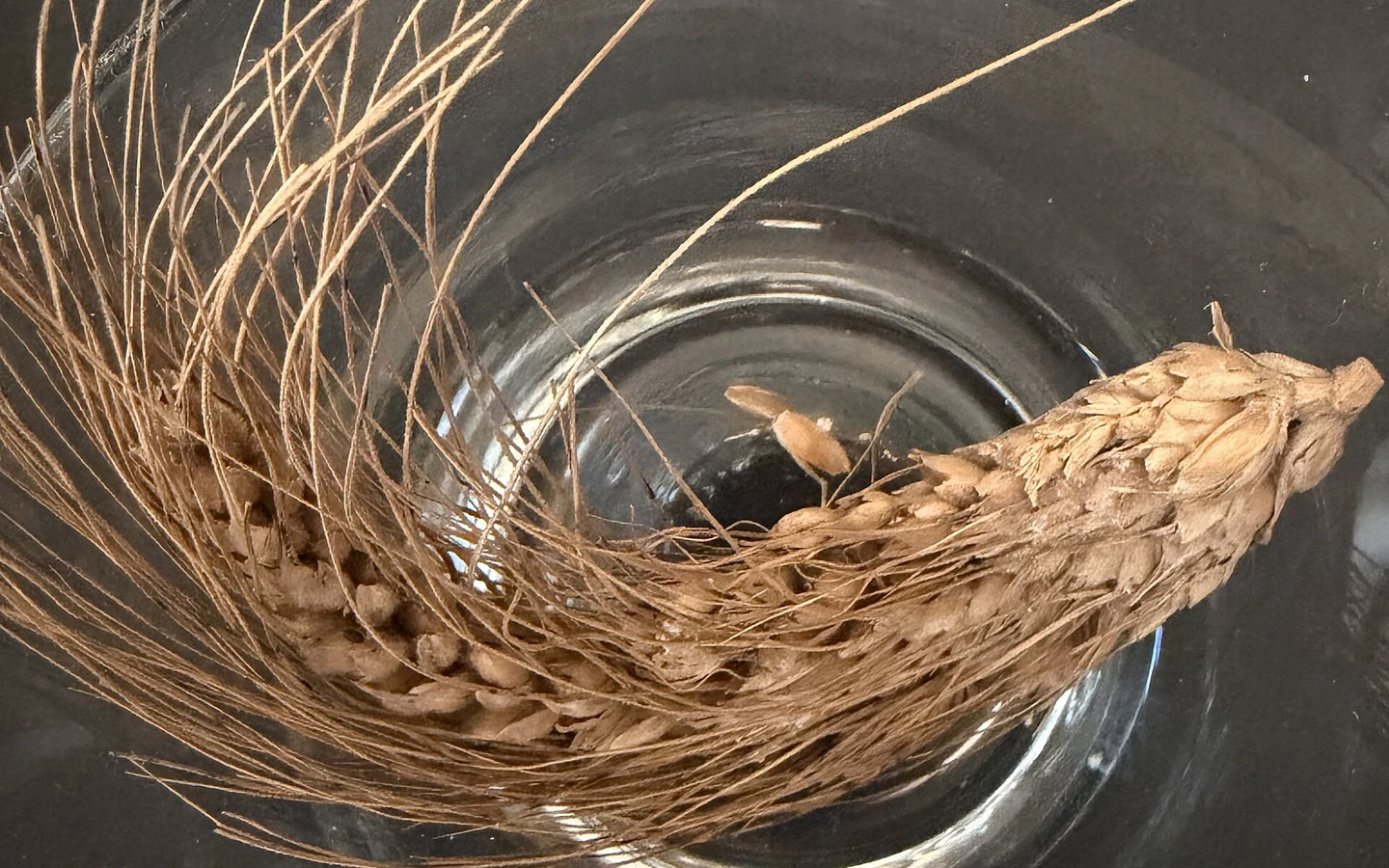
The four wild wheats, plus cultivated einkorn, emmer and spelt, all have hulls. In this more primitive form, hardened glumes enclose the grain tightly. The domesticated species also have a semi-brittle rachis, so the ear breaks into spikelets during threshing, and those spikelets must be milled or pounded again to free the grain.
Durum and common bread wheat are free-threshing. Their grain separates from the chaff in a single operation.
That difference determined which wheats became dominant, and it still shapes supply today. Dehulling is an extra processing step with its own yield loss and its own equipment. It is the main reason these grains cost more and appear less often as whole grain than as flour, and it is why the grain you buy is either already dehulled or requires work you may not be equipped for.
The gluten question, measured
The claim most often attached to ancient wheats is that their gluten is somehow gentler. The measurable position is more specific and more interesting than that.
A 2023 study in Foods measured gluten content in three ancient Italian varieties, expressed as grams per kilogram of dry matter. Saragolla ranged from 97.15 to 99.59, Risciola from 88.64 to 93.75, and Carosella lowest at 67.39 to 76.49. The study also found that degree of sifting made no significant difference to gluten content within a variety, which is a useful negative result: sieving out bran does not change how much gluten the flour carries.
Its qualitative conclusion, drawing on earlier work, is the one worth remembering: ancient varieties have a higher and weaker gluten content, with modern varieties having been improved for both gluten index and protein content. More gluten, less strength. That combination explains a great deal of what bakers report about these flours, including doughs that feel abundant and slack at once, and loaves that spread rather than spring.
The same study measured ash content, highest in whole meal samples at 1.20 to 2.04 per cent, and notes that most minerals sit in the outer layers of the kernel and that these minerals do not ash at the 550 degrees Celsius used for the determination.
What is known about nutrition, and what was not
The 2023 mineral study is candid about the state of the evidence at the time it was written: it states that no research then existed on the mineral content, phytic acid content, and phytase activity of spelt, emmer and einkorn, and stresses that cross-species comparison requires enough varieties of each species grown across multiple environments.
Its own spelt findings show that the interesting variable is often processing rather than species. Averaged across three spelt varieties, phytic acid fell from 10.6 in the flour to 6.4 in the bread, calcium rose from 232.3 to 332.5, and zinc rose from 18.6 to 22.0, all statistically significant. FODMAPs fell from 3754.3 in flour to 2646.3 in bread, and within the breads, sourdough averaged 2354.5 against 3083.8 for yeasted. Acrylamide moved the other way, averaging 436.7 in sourdough breads against 216.7 in yeasted ones.
Two caveats are mandatory here. The units in the published table are not stated in the portion available, so these figures should be read as relative changes rather than absolute concentrations without checking the original. And every one of those changes is a bread-making effect, not a property of spelt.
Einkorn and gluten intolerance
Because it comes up constantly: the 2015 review notes evidence that einkorn's gliadin may be less toxic to people with coeliac disease than that of modern wheat, and then states the operative conclusion in the same breath. Einkorn has yet to be recommended in any gluten-free diet, and it does contain gluten.
That is the entire defensible position. Einkorn is not a coeliac-safe grain, and no amount of ancientness changes that.
Choosing between them
If the goal is flavour and a different dough feel, all three deliver, and the higher-but-weaker gluten finding is the best predictor of how they will behave: expect extensibility without strength, and handle accordingly.
If the goal is a specific nutritional outcome, the evidence base is thinner than the marketing, and the comparison that showed the largest effects was between two fermentation methods rather than between two species.
And if you are buying grain rather than flour, ask whether it has been dehulled. That question has a definite answer, and it matters more to your afternoon than the ploidy level does.