A source-informed practical guide. Examples explain decisions and arithmetic; they are not claims of a kitchen trial by this publication.
Flour is normally a raw ingredient, and an egg-free dough is not automatically ready to eat. FDA guidance says not to taste raw flour, dough or batter. Follow a recipe or package's cooking directions rather than deciding safety from a pleasant smell. This matters when baking with children as well as when preparing food for yourself.
Organise the counter before mixing
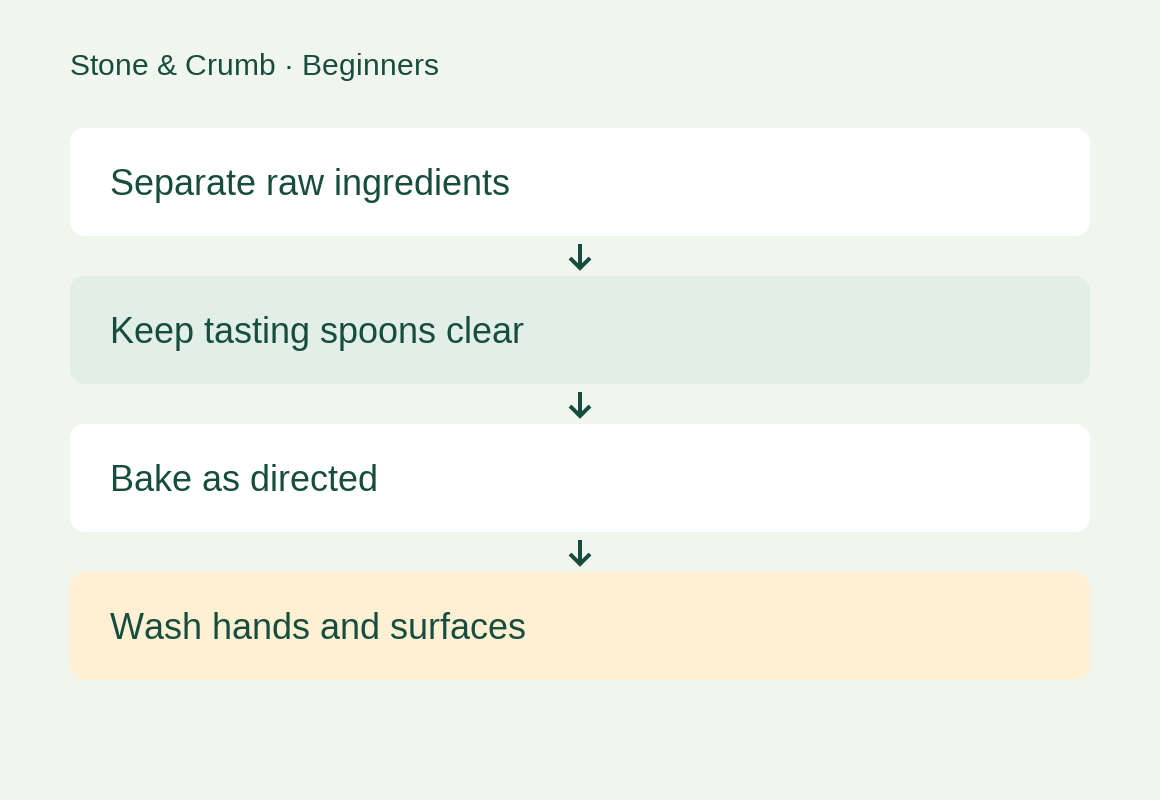
Put cooling cakes, washed fruit and finished icing on a different working area from the raw flour station. Open flour bags carefully and avoid shaking dust over nearby food. Set aside a clean utensil for finished food rather than reusing the spatula that handled raw batter. Keep packaging instructions available until the batch is complete.
A practical household sequence is to prepare decorations first, cover them and move them away, then begin mixing. When space is limited, finish and clean one task before starting the next. This arrangement reduces the number of times you have to move between raw and ready-to-eat work.
Tasting is a separate task
Do not lick beaters or offer raw dough to children. Removing the egg alone does not remove the raw-flour issue. If you want a ready-to-eat dough dessert, use ingredients specifically intended for that purpose and a suitable validated preparation. Do not treat an improvised microwave or oven treatment as a guarantee that ordinary flour is now safe to eat raw.
Put tasting spoons near the finished-food area, not in the mixing bowl. If flavour needs adjustment in a recipe that permits it, evaluate a properly cooked test portion. For a cake batter, repeated tasting is not a reliable way to predict the finished sweetness anyway.
Make the end of the bake unambiguous
Follow the full baking directions for the product, including portion size and oven conditions. Colour or a clean-looking surface alone does not establish that a thick centre was adequately cooked. A thermometer, where a recipe specifies one, must be used at the stated location and interpreted for that food. There is no single temperature in this guide that validates every cake, cookie and filled pastry.
A quality defect and a safety decision are different. A fully baked but dry cake may be suitable for another cooked serving idea if its ingredients and storage history are appropriate. Batter with an uncertain storage history should not be relabelled as a pudding simply to avoid waste.
Close the session with a clean reset
Wash hands after handling raw ingredients and before touching finished food. Clean bowls, tools and work surfaces after mixing; give particular attention to handles and switches touched with flour-covered hands. Check beneath the scale and around the opened flour bag when putting equipment away.
Label any retained raw mixture with its identity and preparation time, and follow the relevant recipe, package and local storage advice. When you cannot establish its handling history, avoid a rescue experiment. For texture problems in a batch with a known safe process, continue with failure troubleshooting.