A source-informed practical guide. Examples explain decisions and arithmetic; they are not claims of a kitchen trial by this publication.
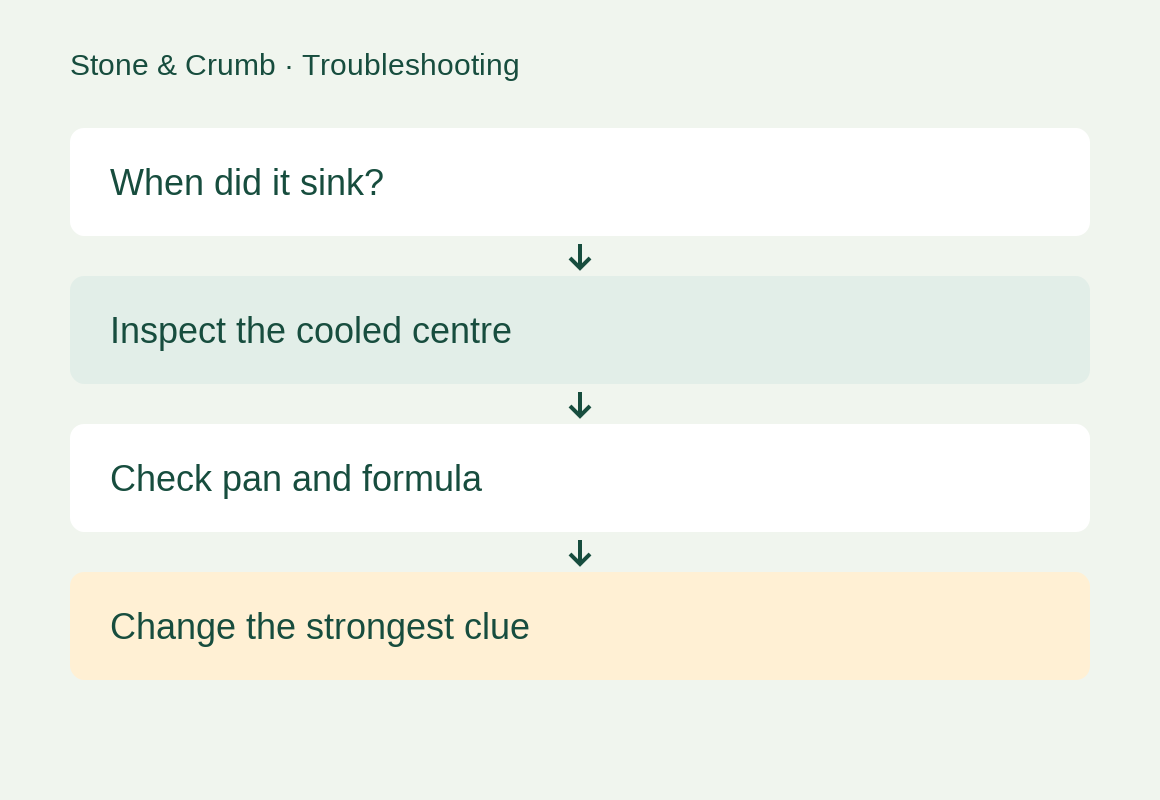
A sunken centre tells you that the cake could not retain its structure, but it does not identify one cause. Start by recording when the collapse appeared: during baking, as the cake left the oven or later while cooling. Then examine a cooled slice and your recipe notes. Adding more baking powder without that evidence may make the next cake worse.
If the centre was still unset
Compare the middle with the edges. A wet batter-like centre and a firm perimeter suggest uneven setting or an early finish. A deep pan, excess batter or a changed oven mode can leave the centre behind while the surface looks ready. Use the recipe's full doneness checks on the next attempt instead of judging the crust colour alone.
Do not disguise uncooked batter with frosting. If the cake is still in the oven, follow the recipe's guidance on continued baking and any permitted protection from overbrowning. Once the cake has collapsed and cooled, reheating is not a reliable way to recreate its original structure or validate an uncertain handling history.
If the crumb is dense rather than visibly raw
An uneven lower stripe can also point toward mixing or support problems. Check whether butter remained at the bowl base, eggs were added too quickly or the specified mixing sequence was changed. Both insufficient combination and excessive aeration can be relevant in particular formulas. Appearance alone cannot tell you exactly which happened.
Photograph a central slice and write down what you observed while mixing. A note such as “cold butter lumps remained after the eggs” gives you a concrete variable to address. “The cake failed” does not. See butter cake checkpoints for a stage-by-stage inspection.
Check changes to the formula
Was sugar reduced, flour exchanged or liquid increased? Was a heaped spoon used for leavener? Did an ingredient already contain baking powder? Several simultaneous substitutions make the diagnosis uncertain. Return to the original tested formula before trying another redesign. High-altitude conditions can require a tested adaptation as well.
Compare the actual pan with the specified internal dimensions and material. If you scaled the batter without changing the pan, you changed its depth. The pan converter estimates quantity for a comparable depth; it cannot calculate a new exact baking time.
Choose one next experiment
For a clearly wet centre, first restore the specified pan and verify doneness. For a dense stripe accompanied by mixing problems, restore ingredient preparation and scrape the whole bowl. For an unexplained rise and fall after several substitutions, restore the original formula. Keep the other conditions unchanged.
This is a way to narrow causes, not a promise that one symptom has one explanation. If the same failure persists, gather recipe weights, pan dimensions, oven mode, timings and a cooled cross-section before seeking recipe-specific help. That package of evidence is much more useful than the height of the cake at its peak.