Among the objects associated with bread, one type recurs across an unusually long span and an unusually wide geography: the stamp or mould used to impress a design into dough before baking. Catalogued examples let us trace it with dates and materials rather than by assertion.
The Byzantine end
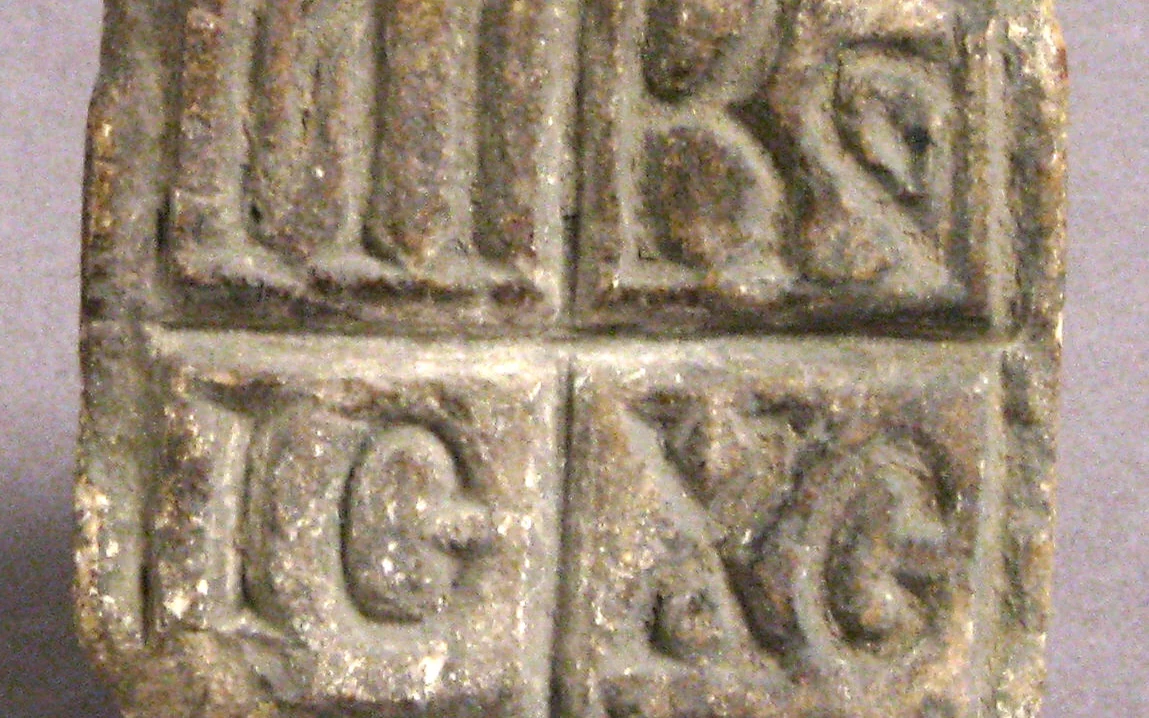
The Metropolitan Museum of Art holds accession 1999.519.17, catalogued as a Bread Stamp, Byzantine, dated between 500 and 900, made of fired ceramic, held in the department of Medieval Art, and received as a gift of the estate of Lawrence J. Majewski in 1999.
Fired ceramic is the significant detail. A ceramic stamp is a moulded and kiln-hardened object, which implies both an established form and enough demand to justify making it in a durable medium rather than carving it as needed.
The Cleveland Museum of Art holds a closely related object, accession 1951.152, catalogued as a Mold for a Eulogia (Blessing) Bread, with a creation date of the 600s to 900s and its culture recorded as Byzantium, Palestine, Byzantine period, seventh to tenth century.
The Cleveland entry names the function explicitly. A eulogia is a blessed bread, and impressing it identified it as such. The stamp therefore performed a religious rather than a commercial act, marking bread as belonging to a particular category of use.
Note also the difference in catalogue language between the two: one is a stamp, the other a mould. A stamp presses a design into a surface; a mould shapes the object. That distinction matters technically, and it is the sort of detail that only survives if you read the institution's own wording rather than a summary.
The Islamic seals
The same New York collection holds a group of four objects, accessions 27.138.1 through 27.138.4, each catalogued as a Bread Seal, dated to the tenth century, made of earthenware, held in the department of Islamic Art, and acquired through the Rogers Fund in 1927.
Four related objects entering together under one fund in one year usually indicates a single purchase, and the sequential accession numbers reflect that. Whatever the group's origin, the record is that a museum acquired four examples of the same functional type at once, which suggests they were not rarities.
The term seal, as against stamp, carries an implication of authentication. A seal ordinarily attests something: origin, ownership, or authorisation. Whether these tenth-century objects marked bread as coming from a particular baker, a particular institution, or a particular quality is not stated in the catalogue entry, and I am not going to guess.
What is documentable is the continuity. Byzantine fired ceramic in the fifth to tenth centuries; earthenware in the tenth century in the Islamic world. The same technology, applied to the same problem, across a cultural boundary usually treated as a dividing line.
The wooden survivals
The later examples are wood. The Victoria and Albert Museum holds museum numbers 661-1893 and 662-1893, both catalogued as bread stamps, dated to the nineteenth century, produced in Algeria, in carved wood.
The same museum holds 1204:1-1905, a communion wafer stamp, dated 1877, produced in Greece, in incised wood. That is a liturgical object of the same functional family as the Byzantine eulogia mould, still being made in the same region roughly a thousand years later, now in a different material.
The material shift from ceramic to wood is not necessarily a technological development. Wood is easier to carve, easier to modify, and less likely to survive, which means wooden stamps from earlier periods may simply not have lasted. Collections record what endured, and inferring change from what endured is a standard trap.
The gap: guild marks
The category I could not document is the commercial one.
Marks identifying a baker or a guild are frequently mentioned in accounts of medieval and early modern urban baking, on the reasoning that where loaf weight was regulated, an official needed to know whose loaf was underweight. That is a coherent argument. It is also the kind of claim that ought to be attached to an object.
I searched museum collections for baker's marks and guild bread marks and found nothing I could cite with an accession number. Two large collections that might hold relevant material were unreachable in this working environment.
So the honest position is that stamps used for religious marking are well documented in catalogued collections, while stamps used for commercial identification are not, at least not in the collections I could reach. Whether that reflects survival, collecting priorities, or my search failing is not something I can determine.
What the object type tells us
Three observations that follow from the catalogue entries alone.
The practice is long-lived and geographically broad. Documented examples cover the fifth to tenth centuries in the Byzantine world, the tenth century in the Islamic world, and the nineteenth century in North Africa and Greece.
The function is often religious. Two of the four objects above are explicitly liturgical, one by its Cleveland catalogue description and one by its V and A object type. Marking bread as blessed appears to be the best-documented reason for stamping it.
And the impression was worth the effort. Stamping dough is an extra operation performed on every loaf, requiring a made tool. Societies do not add steps to a staple food process casually, which is a reason to take the practice seriously as evidence about how bread was categorised.
Working with these records
If you want to pursue this, the operative search terms in collection databases are stamp, seal, and mould, and they will return different sets. The Cleveland object would not appear in a search for stamps; the Islamic group would not appear in a search for moulds.
Cite the accession number and quote the institution's own object type. A summary that flattens stamp, seal and mould into one word loses the distinction the cataloguers preserved, and that distinction is most of the technical information available.