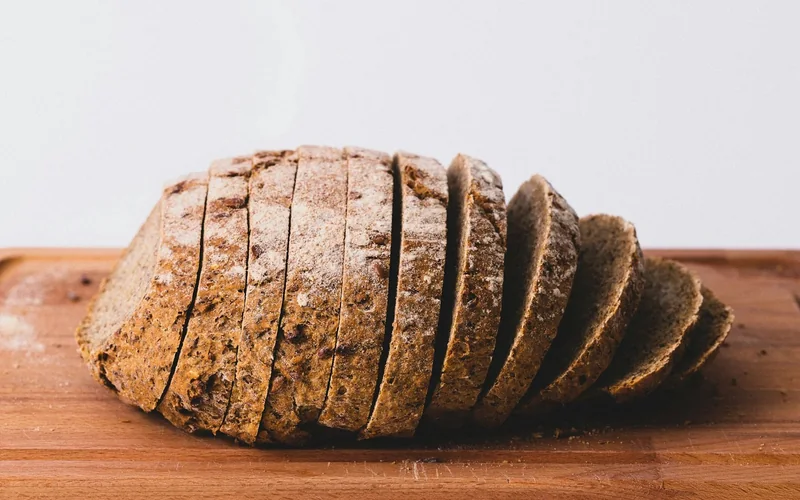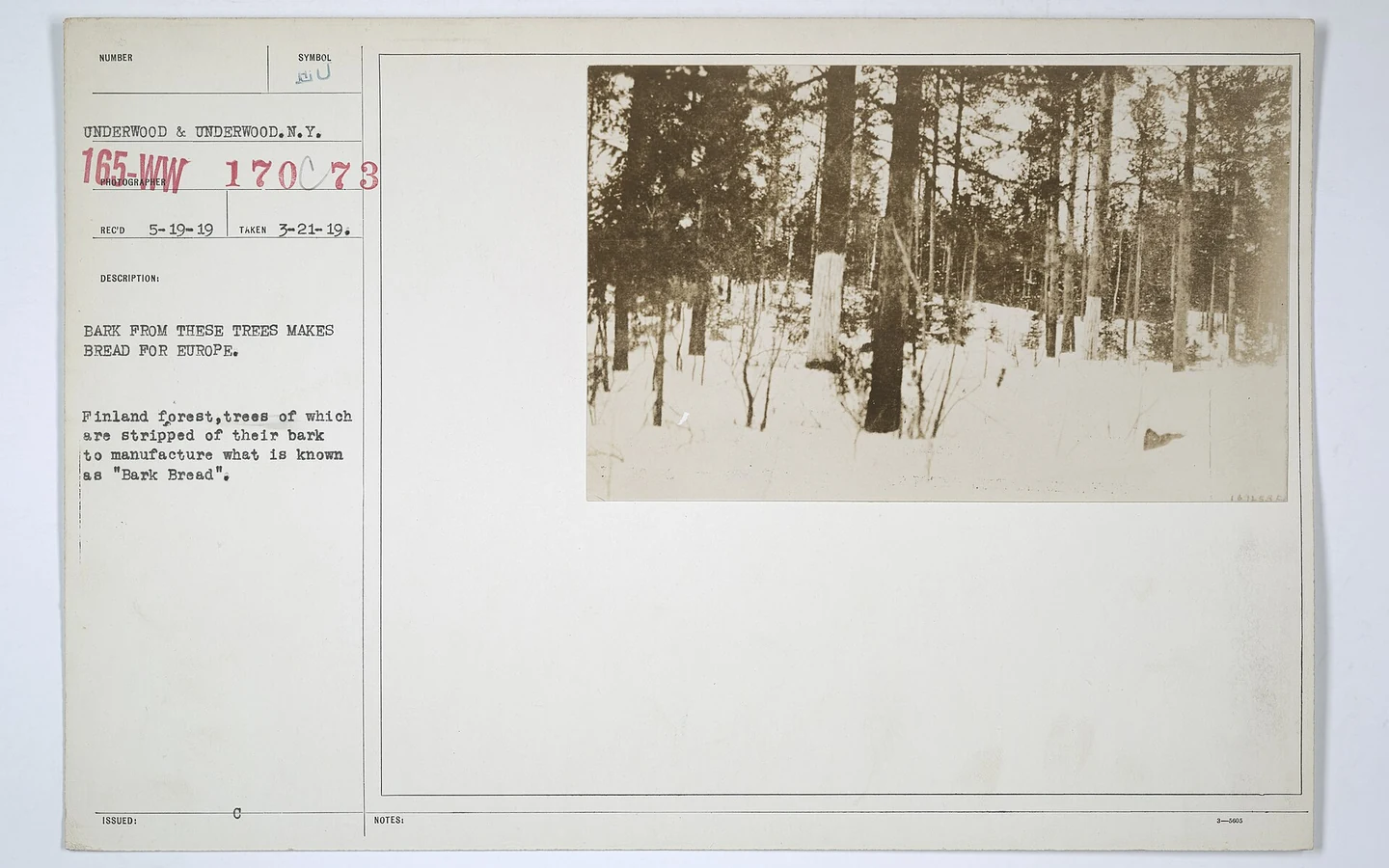
Bark bread is one of the more widely repeated facts about European food history: in famine years, particularly in Finland and northern Sweden, flour was extended with material derived from the inner bark of pine. It appears in popular accounts, museum interpretation, and food history writing. It is also, on the evidence I was able to reach, considerably harder to document than its ubiquity suggests.
This article is therefore partly about a subject and partly about the limits of a research method. I think the second is worth reading, because famine food is exactly the kind of topic where confident detail accumulates without much scrutiny.
What can be established
Two contemporary scientific notices exist, and their dates are precise.
Nature published an item titled Bark Bread on 4 March 1886. Scientific American Supplement published an item under the same title on 24 April 1886.
Seven weeks apart, two general-science periodicals on different continents each carried a piece on the subject. That tells us the practice was a matter of scientific interest in the mid-1880s, roughly two decades after the Nordic famine years usually associated with it, and that it was considered novel or notable enough to report.
I could confirm the titles, journals and dates through bibliographic records. I could not read either notice. So I cannot tell you what they described, what analysis they reported, or what conclusions they drew.
The famine the scholarship addresses
The historical event behind most bark bread accounts is the Nordic subsistence crisis of the late 1860s.
A monograph published in 1988, titled Bitter bread and subtitled as a study of the famine in Norrbotten in 1867 to 1868, addresses the Swedish side of it. Its scholarly standing is indicated by a review in the Journal of Interdisciplinary History in 1990.
The Finnish side has been treated in university press scholarship, including a chapter published by Oxford University Press in 2002 on nineteenth-century Finnish famine mortality. Further work exists on how the Finnish famines of 1856 to 1868 were perceived in British opinion, and on Danish relief efforts directed to Sweden and Finland in 1867 and 1868.
Those citations establish that this is a properly studied historical episode with a mortality literature and an international relief dimension. Once again, I confirmed their existence and publication details without reading their contents.
What I will not write
Descriptions of how bark flour was prepared circulate freely: which species, which layer, what treatment, in what proportion to grain. I am not going to reproduce any of them here.
The reason is specific rather than squeamish. Statements of that kind are exactly the ones that drift. A plausible-sounding processing detail, repeated often enough, becomes a fact with no traceable origin, and I have no source in hand that states any of it. If the 1886 notices contain such detail, they would be the right place to get it, and they are not accessible to me.
Nor will I quantify anything: not how many people relied on such bread, not what proportion of a diet it represented, not its nutritional contribution. Every one of those numbers requires a source, and I have none.
Why the primary record resisted
The specific obstacles are worth naming, because they will affect anyone attempting the same research.
The large-scale digital libraries that hold out-of-copyright periodicals and nineteenth-century agricultural reports were unreachable in this working environment. So were several national digital collections in the Nordic countries, and a major European cultural aggregator.
What remained accessible were bibliographic and catalogue systems: publisher metadata, a research library catalogue, and citation records. Those are excellent for establishing that a publication exists, who issued it and when. They are useless for content.
That asymmetry produces a particular kind of article: strong on provenance, empty on substance. Rather than disguise it, it seems better to show what a bibliographic-only research position actually yields.
How to evaluate a famine food claim
Generalising from this exercise, a few tests are worth applying whenever you meet an account of historical substitute foods.
Ask what the source is for the processing detail. Preparation methods are the most commonly stated and least commonly sourced element. A claim that names a specific species and a specific technique should have a specific source behind it, ideally a contemporary one.
Distinguish the event from the practice. That a severe famine occurred in a specific region in specific years is usually well documented, often with mortality figures. That a particular food was eaten in it is a separate claim requiring separate evidence.
Watch the direction of the reporting. The 1886 notices postdate the 1867 to 1868 crisis by roughly twenty years. Retrospective scientific interest in a famine food is not the same thing as documentation from the famine, and a nineteenth-century notice may itself be relaying second-hand accounts.
Prefer sources that name their own limits. The historical literature on Nordic famine mortality is quantitative and careful precisely because its authors had to establish what the records could support. Popular retellings inherit the vividness and drop the caution.
What this leaves standing
Three statements survive the process. A subsistence crisis in northern Sweden and Finland in 1867 and 1868 is the subject of an established scholarly literature including mortality analysis and relief studies. Bark bread was a recognised topic in general scientific periodicals by 1886, appearing in two of them within weeks. And the detailed characterisation of that bread, which is the part everyone actually wants, is not something I can source.
That is a thinner result than the other articles on this site, and the thinness is the finding. Famine foods are remembered vividly and documented poorly, and the gap between those two facts is where most of what people believe about them lives.