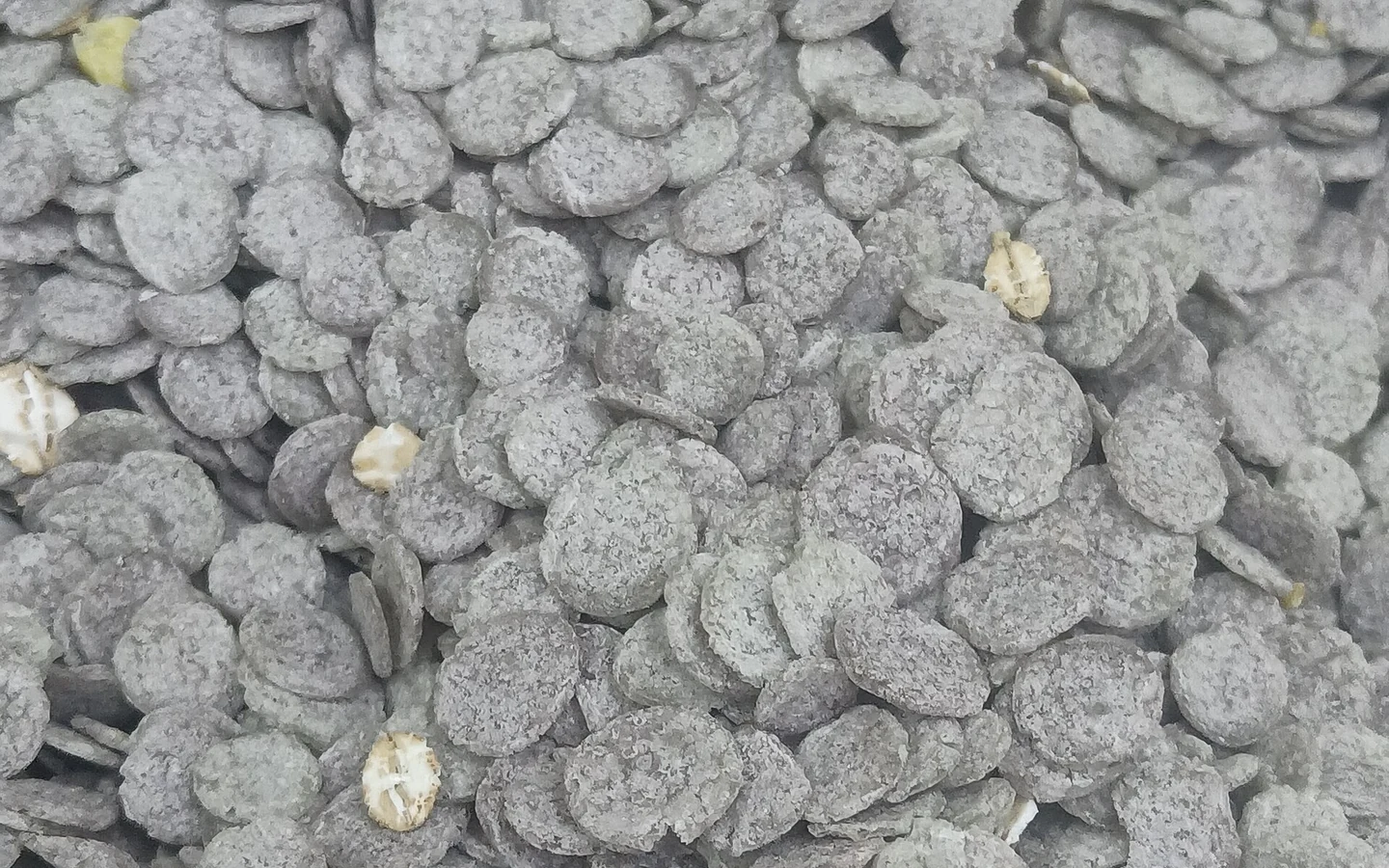
Buckwheat is treated as a grain, sold next to grains, and milled like a grain. Botanically it has nothing to do with them. It belongs to the Polygonaceae, the knotweed family, and is a dicotyledonous pseudocereal rather than a grass. Its fruit is an achene, a dry single-seeded fruit, not a caryopsis.
That is not pedantry. The family difference produces a different internal architecture, and the architecture is why buckwheat behaves as it does in a bakery.
Where the protein sits
In cereal grasses, protein is concentrated in the endosperm: roughly 80 to 90 per cent of it, with only 10 to 20 per cent in the germ. Buckwheat inverts this. About 55 per cent of its protein sits in the embryo and about 35 per cent in the endosperm.
Milling consequences follow immediately. Fractionating a wheat kernel to isolate endosperm captures most of the protein. Doing the equivalent to buckwheat leaves much of the protein behind in the fraction being removed. Published figures for buckwheat fractions show it: starch runs 55.8 per cent in the whole grain, 40.7 per cent in the bran and 78.4 per cent in the flour, while protein runs 11.7, 21.6 and 10.6 per cent respectively. The bran carries twice the protein of the flour.
The protein quality is unusually good. Buckwheat's lysine amino acid score is reported at 100, a figure cereals do not reach, and its biological value exceeds 90 per cent. Protein digestibility, however, is only 79.9 per cent, which tempers the picture: high quality protein that is comparatively less available.
Other whole-grain figures from the same source: fat around 3 per cent, crude fibre at 12.7 and 17.8 per cent in the fractions measured, and tannins at 1.76 and 1.54 per cent. Protein across species ranges from 11 to 15 per cent.
Two species, one enormous difference
Common buckwheat and tartary buckwheat are not interchangeable, and the sharpest difference is in rutin, the flavonoid most often cited as buckwheat's functional component. Seed rutin content is reported at 0.022 per cent of dry weight in Fagopyrum esculentum against 1.32 per cent in Fagopyrum tataricum.
That is a roughly sixty-fold gap. Any claim about buckwheat's rutin content that does not name the species is close to meaningless, and tartary buckwheat's characteristic bitterness is part of the same package.
Buckwheat also remains an agronomically awkward crop. A 2025 study of morphological variation across dozens of accessions identifies persistent breeding constraints including seed shattering and pre-harvest sprouting, which helps explain why buckwheat has not consolidated into a small number of uniform commercial varieties the way wheat has.
How the pseudocereals compare
A 2026 comparison puts buckwheat alongside its usual companions and wheat, in grams per 100 grams. Protein: buckwheat 5.7 to 16.4, amaranth 12 to 22, quinoa 13.1 to 14.1, wheat 10 to 14. Lipids: buckwheat 3.4 to 7.4, amaranth 6 to 13, quinoa 4.7 to 5.5, wheat 2 to 3. Fibre: buckwheat 10.0 to 21.5, amaranth 9 to 14, quinoa 7 to 14.7, wheat 10 to 13.
The ranges are wide, which is itself the finding. Buckwheat's protein range spans nearly threefold, so a single figure for buckwheat flour protein is not a reliable planning number. What holds across the comparison is that the pseudocereals carry two to four times the lipid of wheat, which links directly to their shorter shelf life.
Starch granules differ too, which matters for hydration and gelatinisation. Buckwheat granules measure 2.0 to 9.0 micrometres, amaranth 1.0 to 1.3, and maize 5.0 to 30.0. Maize also illustrates how much amylose content can vary within one species: 22.7 per cent in normal maize, 2.5 per cent in waxy and 71 per cent in high-amylose types.
The structural gap, quantified
None of these flours forms a gluten network, and the resulting deficit has been measured rather than merely asserted.
A 2021 study reports that its control gluten-free bread reached half the specific volume of a wheat bread and was eight to nine times firmer. That is the gap any gluten-free formulation has to close.
The same study tested psyllium fibre at 2.86, 7.14 and 17.14 per cent. Psyllium raised specific volume by around 50 per cent and reduced firmness by 65 to 75 per cent. The highest level, 17.14 per cent, produced the longest delay in staling.
A 2026 review sets those numbers in context by comparing the common hydrocolloids at their typical use levels. Xanthan with guar gum at 0.5 to 1.5 per cent gives volume increases of 10 to 15 per cent. Hydroxypropyl methylcellulose at 2 to 3 per cent brings loaves close to a wheat control. Psyllium at around 5 per cent produces volume increases of two to three times.
Read together, these establish an order of magnitude for each option, and they explain why formulations differ so much in the amount of additive they use. Gums at half a per cent and psyllium at seventeen are not variants of one approach; they are working at different scales.
Why granule size and antinutrients matter here
The granule figures above are not trivia. A flour whose starch granules run 2 to 9 micrometres presents far more surface area per unit mass than one running 5 to 30, which changes how quickly it takes up water and how early it begins to gelatinise. In a formulation that has no gluten network to slow things down, that shift in timing shows up directly in how the batter sets during the bake, and it is one reason recipes developed for maize starch do not transfer cleanly to buckwheat.
Two other measured properties belong in the same practical picture. Buckwheat's tannin content, reported at 1.76 and 1.54 per cent in the fractions measured, contributes astringency and interacts with protein. And its protein digestibility of 79.9 per cent sits well below the figure its amino acid score alone would suggest, which is a useful corrective to reading a lysine score as a nutritional conclusion.
What this means for a baker
Buckwheat's contribution to a gluten-free formula is flavour, colour, protein quality, and fibre. It is not structure. The structure has to come from a hydrocolloid, from starch selection, or from both, and the published effect sizes above are the realistic expectations.
If you are buying buckwheat flour, two questions do real work. Which species, because of rutin and bitterness. And whether the flour is light or whole, because the protein is in the fraction that light flour removes, which inverts the intuition carried over from wheat.
And treat it like the oily flour it is. At two to four times wheat's lipid content, buckwheat flour has a shorter useful life than the white flour beside it on the shelf.