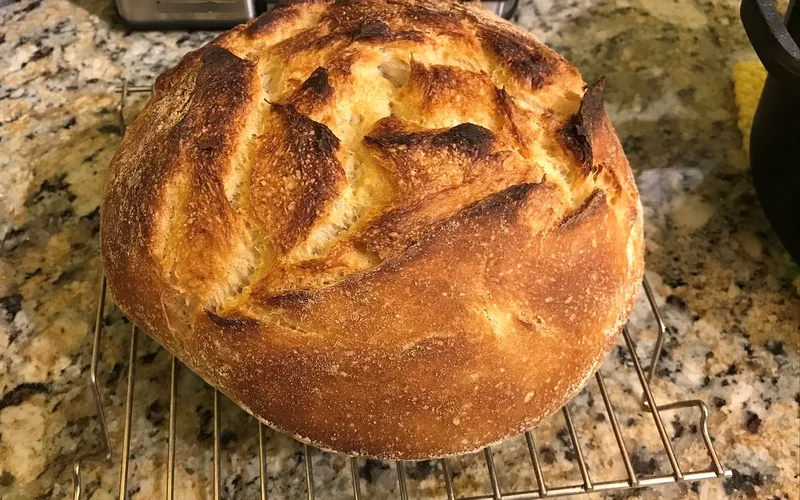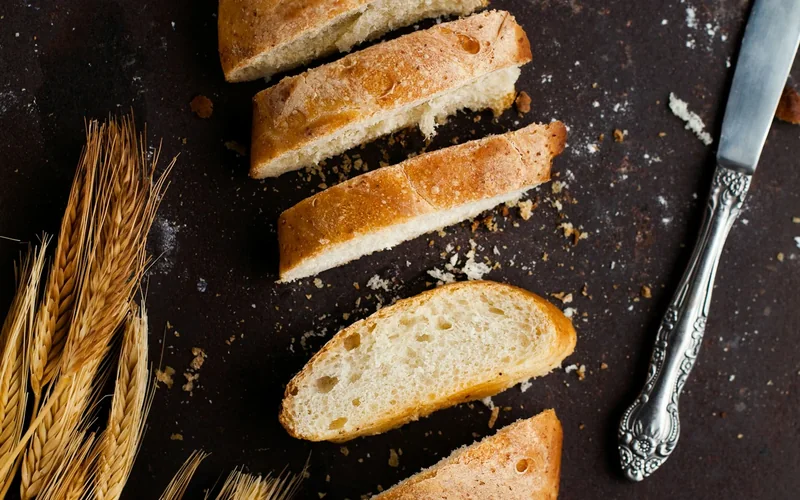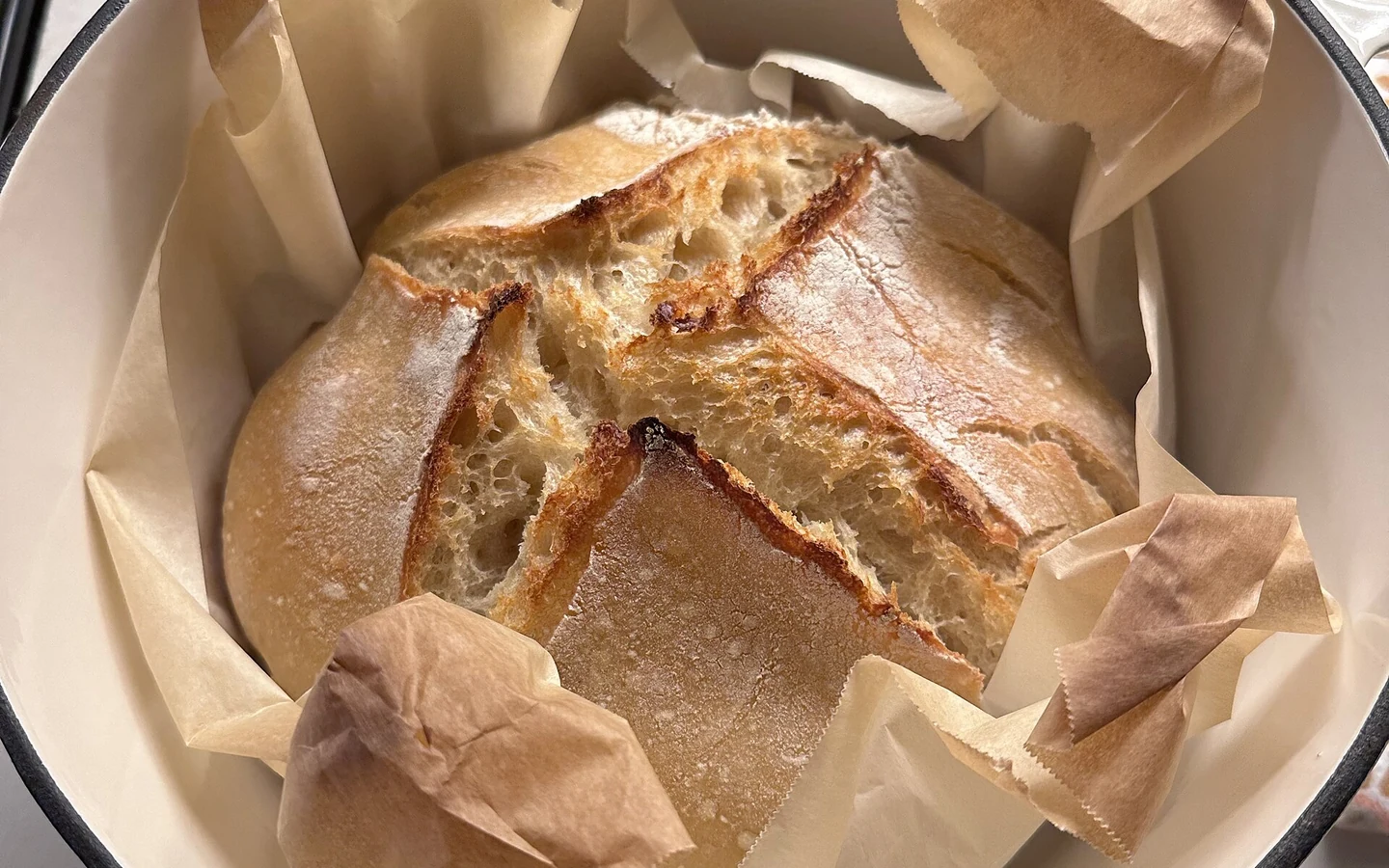
Baking a loaf in a preheated lidded pot has become standard advice for home bakers, and the reasoning offered is always the same: the lid traps steam released by the dough, which does what a steam-injected bakery oven does. That reasoning is sound. What is missing is any study testing it.
First, the gap
I searched the biomedical and food science literature for controlled comparisons of covered and uncovered baking in a closed vessel. The searches return studies of recipes, of starch behaviour, and of sensory evaluation. On the specific question of a lidded pot against an open bake, there is nothing. The only hit matching the phrase Dutch oven concerns lead exposure from metal cookware.
So this article cannot report an effect size. It can trace the mechanism through three measurements that do exist, and it can be honest that the connection between them and a finished loaf has not been closed experimentally.
The dough supplies the water
A 2025 study of temperature evolution during baking reports a dough sample containing 64.5 grams of liquid water, and describes continuous water loss throughout the bake, with the interior temperature holding at a 100 degree plateau.
That plateau is the signature of evaporation controlling temperature. While free water remains and is turning to vapour, the interior cannot climb past the boiling point, because incoming energy is going into the phase change.
A loaf therefore emits water vapour continuously and copiously from the moment its surface passes 100 degrees. In an open oven that vapour disperses. In a sealed vessel it accumulates until the atmosphere inside is saturated.
Nothing needs to be added. The lid does not create steam; it prevents the loaf's own steam from leaving.
Saturated vapour is a heat delivery mechanism
The reason that matters is not primarily about surface softness. A 2020 review of oven heat transfer treats condensation as a heat transfer path in its own right, reporting it at 15 per cent of total transfer in a commercial deck oven operating with steam.
More instructive is what happens when water is introduced to an oven that had none: conduction, convection and radiation contributions all decrease, because condensation has become an additional channel. Steam takes over part of the heat delivery from the other three.
Apply that to a lidded pot. Water vapour condensing on the still-cool dough surface releases its latent heat there. The surface heats faster than dry air at the same temperature would heat it, while simultaneously staying wet and therefore extensible. The two effects that look contradictory, faster heating and delayed setting, are both consequences of condensation.
An open chamber cannot hold humidity
For contrast, consider what an open oven does with vapour. The 2022 characterisation of a wood-fired oven with a mouth 44 by 22 centimetres recorded ambient air at 36.4 degrees Celsius and 20.4 per cent relative humidity being drawn continuously into the chamber.
An oven with a permanent opening ventilates itself. Dry outside air enters, mixes, and carries vapour away. Whatever the loaf emits is diluted and removed.
A domestic oven with a door seal is better than that, but it still vents, and every time the door opens the cavity exchanges its air. The sealed vessel differs in kind: it is a small volume that the loaf can saturate and keep saturated.
Timing follows from the expansion window
The same 2025 study measured when expansion finishes. Lateral height stabilised around 450 seconds into the bake; central height continued to roughly 900 seconds before settling.
That sets the useful duration of the covered stage. A lid maintains a humid environment during the period when the surface must stay extensible, and it has nothing left to contribute once the structure has set. The conventional instruction to remove the lid partway through corresponds to that boundary, and the measurement gives it a numerical basis of the order of eight to fifteen minutes rather than an arbitrary one.
Removing the lid then serves the opposite purpose: the surface needs to dry for the crust to become crisp and to brown, and a saturated atmosphere prevents both.
What cannot be said
Several things are commonly asserted that the available evidence does not reach.
That a cast iron pot performs better than a ceramic one. This is plausible on thermal grounds, since preheated cast iron stores and delivers more heat at the base, but no comparison exists.
That preheating the pot is essential. Again plausible, since conduction from the base is a major heat path, and again untested against a cold-start control.
That the lid produces a specific increase in loaf volume. This is the claim most often quantified in home baking writing, and it is the one with no published measurement behind it.
That a lidded pot equals a steam-injected oven. The mechanism is shared, but a commercial oven injects steam into a large cavity from an external supply and can vent it on a schedule. A pot relies on the loaf's own water in a small volume. Whether the resulting condensation flux is comparable is exactly the sort of question the missing study would answer.
What is defensible
The lid retains vapour the dough is measured to release. Retained vapour opens a heat transfer path that measurably substitutes for part of the dry-heat delivery. That path both heats the surface and keeps it wet, which is the condition expansion requires. And expansion is over within roughly a quarter of an hour, after which the same conditions become counterproductive.
Each link is supported. The chain has not been tested end to end, and anyone quoting a percentage improvement from a lidded pot is quoting a number nobody has published. That is not an argument against the method, which plainly works for a great many bakers. It is an argument for describing it as a well-reasoned practice rather than as a measured one.