Recipes specify oven temperature because it is the only oven variable most people can set. It is also a poor description of what an oven does to bread. Temperature tells you the condition of the cavity. Baking depends on how fast energy crosses into the dough, and that rate is divided among several routes whose proportions are a property of the oven's design rather than of its thermostat.
Four routes, in measured proportions
A 2020 review reports the split for a commercial multi-deck oven: conduction 40 per cent, radiation 30, convection 15, condensation 15. For a porous burner plate oven operated without added water, the split becomes radiation around 45 per cent with conduction and convection about 27.5 each, and no condensation term at all.
Those are the same four physical mechanisms in radically different proportions. In the first oven, the largest single contribution comes from the deck the bread sits on. In the second, the dominant contribution arrives as radiation from a hot surface, and the deck's share falls by more than a quarter of the total.
The review notes that certain configurations push radiation as high as 63 to 89 per cent. At that point the oven is closer to a grill than to a masonry chamber, and dough placed in it will behave accordingly: surfaces facing the source set early, surfaces facing away lag.
Wall emissivity is lower than expected
One number in that review corrects a widespread assumption. Oven walls at 200 to 400 degrees Celsius are given an emissivity of 0.2 to 0.3.
Emissivity scales radiative output. A surface at 0.25 emits a quarter of what an ideal radiator at the same temperature would. So the walls of a hot oven, despite being hot, are not delivering much radiant energy compared with a dedicated radiant element. By contrast, the review gives burner plate surfaces reaching around 900 degrees, where output rises steeply with temperature.
This explains why domestic ovens vary so much between models. The distribution of radiant sources, whether an element is exposed or hidden, and how much bare metal faces the food change the radiation share substantially without changing the temperature reading at all.
Where the energy actually goes
A useful way to see why the delivery rate dominates is to look at what a bake consumes.
A 2025 energy analysis of a high-temperature tunnel oven for flatbread gives the mass balance directly: one kilogram of dough entering yields 0.851 kilograms of baked product and 0.149 kilograms of water lost. The analysis uses specific heat values of 2.4 and 3.2 kilojoules per kilogram kelvin for the product and a latent heat of vaporisation of 2,250 kilojoules per kilogram, at an oven setting of 170 degrees Celsius.
Put those together. Evaporating 0.149 kilograms of water requires roughly 335 kilojoules. Raising one kilogram of dough from around 25 degrees to 100, using the higher specific heat figure, requires around 240 kilojoules. That arithmetic is mine, not the study's, and it is rough. But the ranking it produces is robust: driving off water costs more energy than heating the dough to the temperature at which water leaves.
Baking, energetically, is mostly a drying operation. That single fact explains a great deal about oven behaviour, including why loading a cold oven with several loaves stalls it, and why bake times scale with loaf mass much more steeply than intuition suggests.
The efficiency figures are humbling
Two measurements underline how little of the supplied energy reaches the bread.
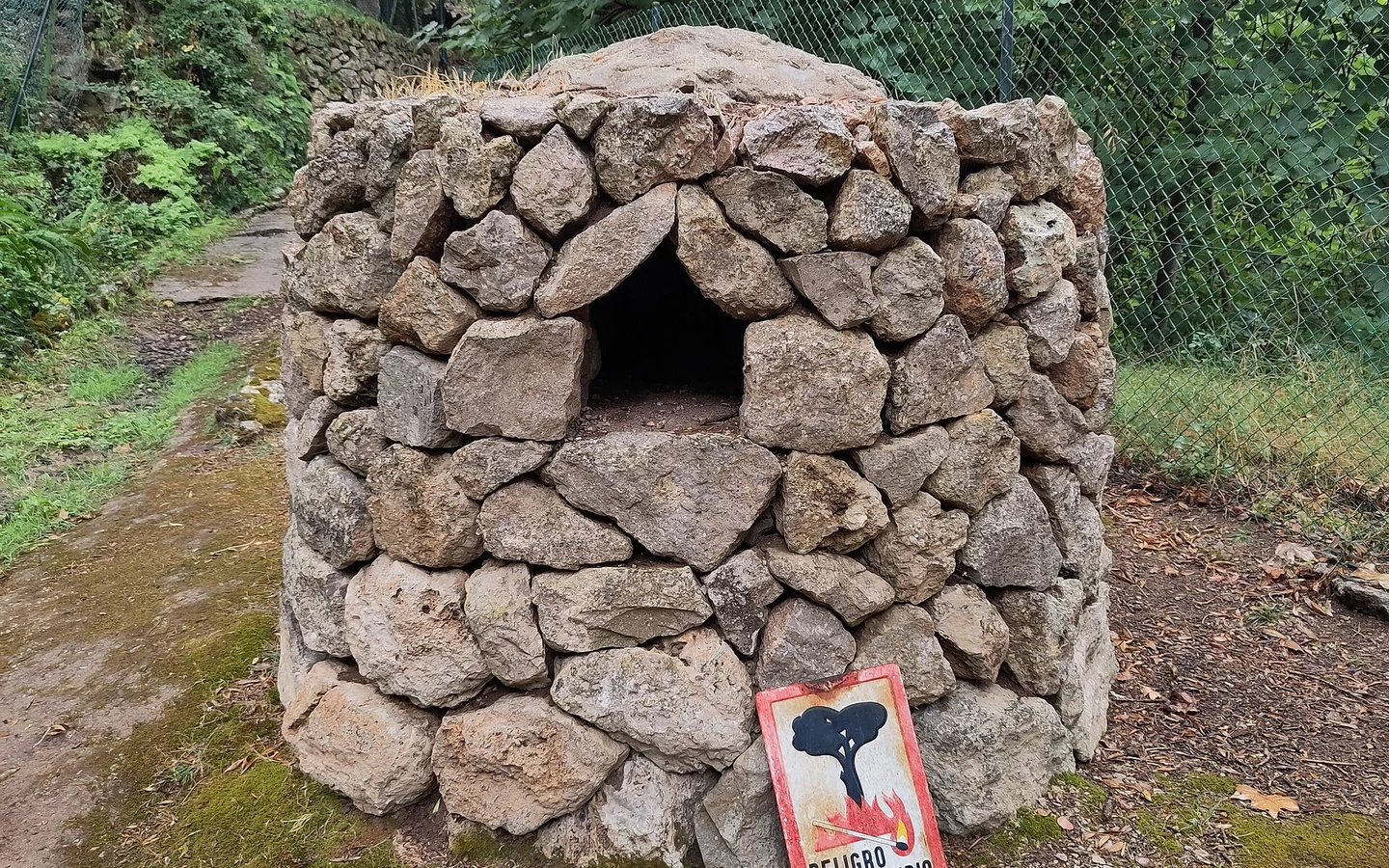
The 2022 characterisation of a traditional wood-fired oven measured thermal efficiency at 13 plus or minus 4 per cent, with ambient air drawn continuously through the mouth. Around seven eighths of the fuel energy is lost.
And a 2023 study of the same class of oven measured its floor at 439 plus or minus 3 degrees Celsius while the dough base reached only 100 plus or minus 9. A 339-degree gradient across the contact interface, sustained by a layer of trapped air and escaping vapour, is not a small inefficiency. It is the normal condition of baking.
Steam changes the accounting
The review adds a finding that matters when comparing a steam oven with a dry one. Introducing water reduces the conduction, convection and radiation contributions, because condensation becomes an additional path taking over part of the delivery.
This is why a steam oven and a dry oven at the same temperature are not the same oven. Their totals may be similar; their routes are not, and the routes determine where heat lands first. Condensation deposits energy on the coolest exposed surface, which early in a bake is the top of the loaf. Conduction deposits it at the base. An oven that delivers 15 per cent of its heat by condensation is treating the loaf's geometry differently from one that delivers none.
What this means for a recipe that travels
Several practical consequences follow, all of them about matching delivery rather than matching a number.
A recipe developed on a stone deck assumes a large conduction share. Moving it to a convection oven with a thin tray removes most of that, and the base will lag whatever the dial says.
A recipe developed in a strongly radiant oven assumes fast surface setting. In a gentler oven the same times will give a paler, thicker-crusted result.
Bake times scale with the water to be removed, not just with temperature, because evaporation is the dominant energy sink. Doubling loaf mass more than doubles the water to drive off relative to the surface available to drive it through.
And the single most useful modification in a domestic oven is adding thermal mass under the bread, because that restores the conduction share which the measured budgets identify as the largest term in ovens designed for bread. A tray of tiles or a heavy plate is a cheaper intervention than a new oven, and it addresses the term that the published heat budgets say matters most.