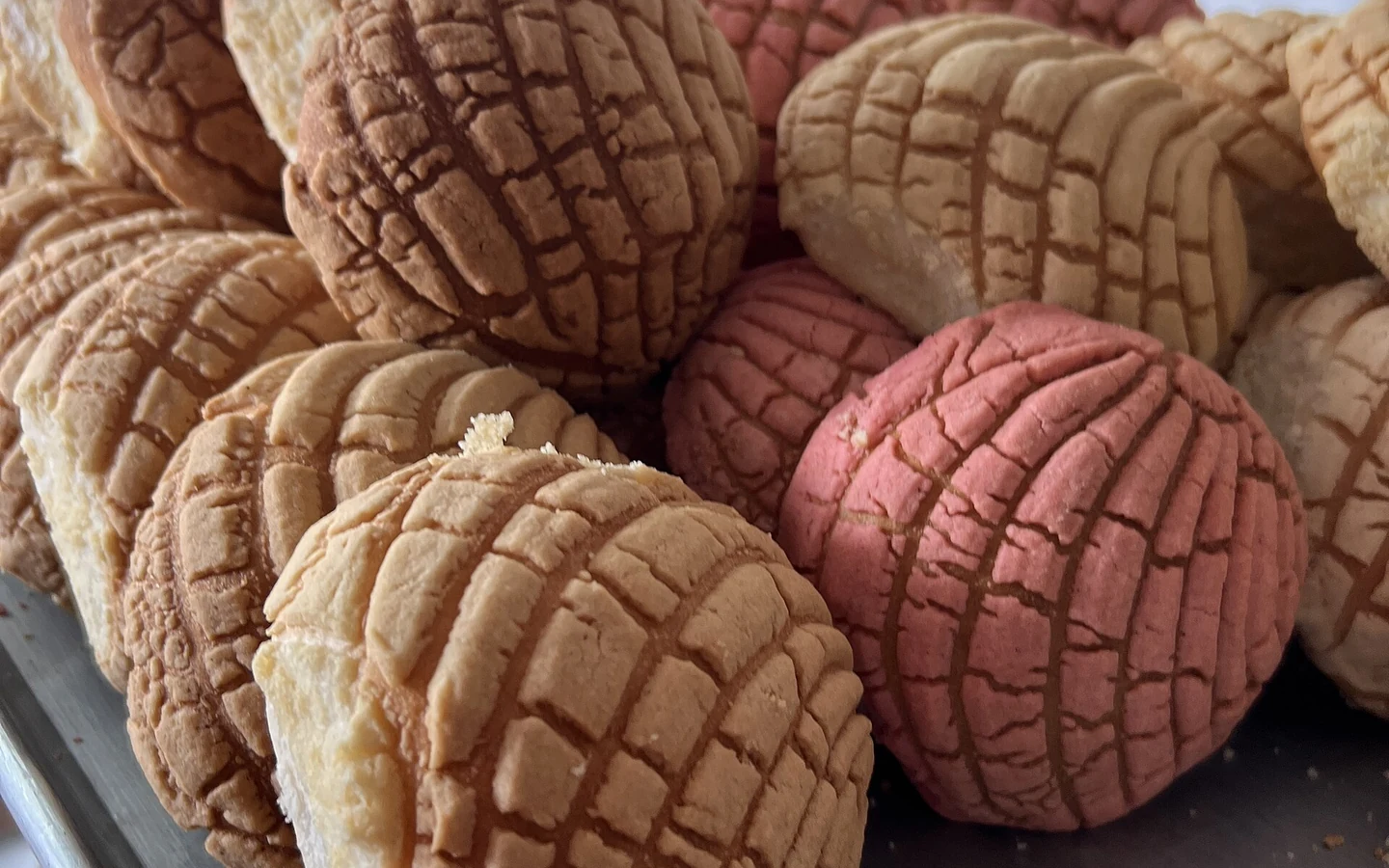
Walk into a Mexican bakery and you meet two counters. One holds plain white rolls, the bolillo and the telera, sold by the piece and gone by lunchtime. The other holds pan dulce, dozens of shapes with their own names. Federal regulation treats these two counters very differently, and the reason lies in how bread has been governed in Mexico for four hundred years.
Pan dulce is an official category
The relevant instrument is NOM-247-SSA1-2008, the Mexican official standard for cereals, flours, semolinas, cereal-based foods and baked goods, issued by the health ministry. Its draft was submitted to the national standardisation committee in 2005, and it is mandatory throughout the country for anyone processing or importing the products it covers.
For the purpose of setting sanitary specifications, the standard classifies baked goods into six groups: filled or coated biscuits, pan blanco, pan dulce, pan de harinas integrales, cake and panqué, and productos de bollería. So pan dulce is not a colloquial umbrella term. It is a legal product class sitting alongside white bread and wholemeal bread.
The standard also defines its terms. Pan blanco is the product of baking a dough made from fermented flour, water and salt, with dough conditioners and improvers, with or without edible oils and fats, milk, other ingredients and food additives. Productos de bollería are baked from a fermented dough prepared with wheat or other cereal flour, water, salt, sugars, edible fats, a leavening agent, additives and optional ingredients. Productos de panificación, the widest term, covers mixtures of cereal or wholemeal or legume flours with drinking water, fermented or not.
Wheat flour itself is defined by exclusion as much as inclusion: obtained by milling mature, whole, broken and dry wheat grain of the genus Triticum, of the species T. vulgare, T. compactum and T. durum or mixtures of these, cleaned, with a large part of the bran and germ removed and the remainder ground to a suitable fineness.
What the standard actually controls
Read for what it regulates rather than what it names, the standard is a public health instrument, not a recipe code.
Wheat flour and nixtamalised maize flour must have thiamine, riboflavin and niacin restored, and must have folic acid, iron and zinc added. Zinc must be added at a minimum of 40 milligrams per kilogram of flour, with zinc oxide as a permitted source contributing the equivalent of 79.54 per cent zinc. Where ferrous sulphate is used as the iron source it should contribute 31.61 per cent ferrous ion, and ferrous fumarate 31.4 per cent. Alternative sources are permitted provided bioavailability is at least equivalent.
Other limits are of the same character. Where ethanol is used as an ingredient it must not exceed 1.99 per cent by weight. For pan blanco, wholemeal bread and bollería, aerobic mesophile counts must not exceed 1,000 colony forming units per gram, and total coliforms must be under 10. Lead and cadmium must be monitored periodically.
Notice what is absent. Nothing in this framework says how much of a bolillo must be wheat flour, what shape a telera takes, how deeply either is cut, or what distinguishes a concha from any other sweetened roll. The standard fortifies the flour and caps the microbial load. The bread itself is left to the baker.
Why the bakery was the regulated unit
This is where the archives are more informative than the standard. Bread in Mexico was regulated for centuries, but at the level of the establishment and the market rather than the loaf.
Colonial trade ordinances for Mexico City include a dedicated bakery section covering 11 July 1600 to 9 September 1603, published in UNAM's edition of the sixteenth and seventeenth century work ordinances. Its items are about labour and accountability rather than composition: indigenous people selling bread on behalf of Spaniards were not to be held liable for unsold bread or the proceeds, except where they exceeded permitted quantities; an official was ordered to count the indigenous workers serving bakers; further items address removing indigenous workers from bakers' houses.
By the early nineteenth century the pattern was entrenched. Research on Puebla's wheat supply between 1810 and 1855 records that the production, distribution, processing and sale of food were regulated by the city council. Posturas, prices, weights, measures and operating permits were controlled by the council's tribunal de la Fiel Ejecutoria. Wheat carried an official price until 1813, which guaranteed a return above production costs and was intended to secure supply, while also benefiting those who controlled the wheat, flour and bread chain. Flour entering the city paid a duty at the gates that formed a significant part of municipal income. And guilds, the study notes explicitly for pork butchers and bakers, pressed inside the council to regulate or restrict access to the food market in line with their own interests.
The scale involved was considerable. An average of 61,557 cargas of flour entered Puebla annually across the period, enough to supply as many as 112,000 inhabitants, in some years close to double the urban population. For most of the period the wheat shed produced a surplus, exceeding demand by up to 70 per cent, and the city was self-sufficient in flour before 1847. By the late 1840s the flour entering the city no longer met demand, a shift the study attributes to sociopolitical, sanitary and environmental factors along with the city economy's move from an agricultural base towards textiles.
Bread mattered enough to justify that machinery. The same work estimates that bread consumption could contribute up to 50 per cent of an adult's required calories, and reproduces per-capita estimates from earlier scholarship, including figures for Puebla around 1790 in the range of 750 to 1,024 grams of bread a day. Those estimates vary enormously between cities and authors, which the study treats as a caution rather than a conclusion.
The workshop survived the regulation
One further finding explains why Mexican bread remained a craft product long after industrial baking arrived elsewhere. Work on late nineteenth-century Mexico City bakeries argues that bread production was organised as a manufactura, a workshop system, and that this organisation persisted from the colonial period well into the twentieth century. That study, built from a dozen Mexico City periodicals, examines bakers' labour culture, contracts that confined workers to the premises for long stretches, and the mechanisms of workplace domination and conflict that followed.
A trade organised in small workshops produces variety rather than standardisation. It also produces local names, which is precisely what the pan dulce counter is: an inventory of shapes maintained by workshops, not by a specification.
What this means when you buy bread
The honest reading is that Mexican regulation guarantees the flour and the hygiene, and the tradition guarantees the rest. If a label says pan dulce, that is a regulated category with sanitary limits attached. If someone tells you what officially separates a bolillo from a telera, ask where it is written, because in the federal standard it is not.