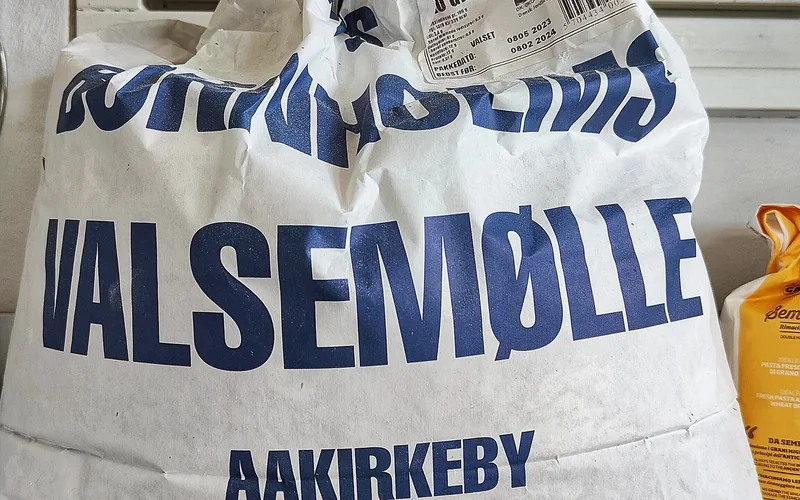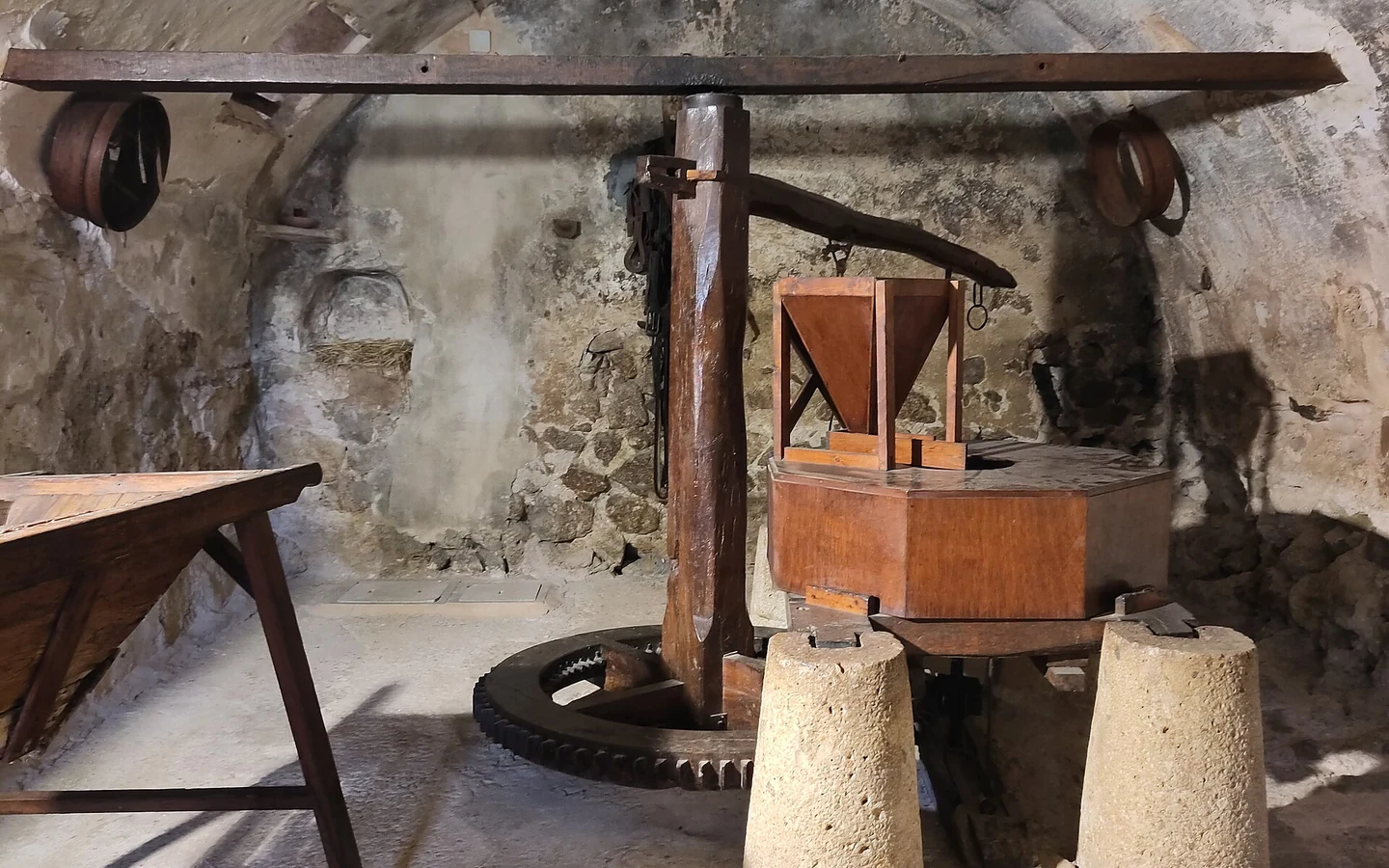
Ask why stone-milled flour is better and you will get an answer about the germ: that stones grind the whole kernel together, keeping the germ oil in the flour, while rollers separate and discard it. That description of the machinery is broadly right. The nutritional conclusion drawn from it is not well supported by the studies that went looking for it.
What the two systems actually do
A stone mill crushes and shears grain between two abrasive surfaces, producing everything at once. A roller mill takes the grain through a sequence of paired steel rolls with sifting between passages, progressively separating endosperm from bran and germ so that the streams can be recombined at will.
The important consequence is that a roller mill is a sorting machine as much as a grinding one. If it produces whole meal, it does so by recombining streams. A stone mill produces whole meal by default and refined flour only by sifting afterwards.
Temperature is often cited as the second difference. A 2022 study reports stone milling at 60 to 90 degrees Celsius against roller milling at 35 to 40, though it is passing on figures from earlier work rather than measuring them. Those numbers are worth treating as indicative of a real difference in direction rather than as precise operating specifications.
Where the lipids sit, and what that means
A 2019 characterisation of milling fractions provides the compositional map. Refined flour streams, at extraction rates between 62.4 and 71.8 per cent, carried ash of 0.54 to 0.98 per cent of dry matter. Whole grain and stone-milled flours, at 100 per cent extraction, carried 1.76 to 2.41 per cent. Fine bran ran 3.38 to 4.15 per cent and coarse bran 6.03 to 7.23 per cent.
The lipid distribution follows the same pattern, and it explains the germ argument. Lipids are concentrated in the germ and outer layers, so any flour that keeps those layers keeps the oil. That is a real difference between a refined flour and a whole meal.
But it is not a difference between stone and roller milling. It is a difference between extraction rates. A roller-milled whole meal that includes all its streams contains the same fractions as a stone-milled whole meal from the same grain.
The studies that tested it directly
Two comparisons make this concrete.
A 2021 study characterised sorghum whole meal produced both ways from the same grain and measured ash at 1.70 per cent for the stone-milled flour and 1.75 for the roller-milled one. That is a difference of five hundredths of a percentage point, which is to say no difference in any practical sense. The same study did find differences in water absorption index, total phenolic content and colour lightness, which are physical and processing-related properties rather than a matter of what fractions are present.
A 2020 study of whole wheat flours went further and stated the negative result plainly: composition did not depend on mill type. What did differ between the flours was particle size distribution, quantified across fractions above 1,000 micrometres, between 315 and 710, and below 250. Gas production during fermentation also differed between the flours.
A 2022 study adds a specific case in the same direction, finding no difference in phytic acid between the two systems, and notes that the literature on damaged starch is in conflict, with different studies reporting the effect in different directions.
Particle size is where the effects live
Once mill type is set aside, the variable that produces measurable differences becomes visible.
A 2025 study compared whole wheat flours at three median particle sizes, 1,315, 450 and 199 micrometres, and found effects on dough stability, loaf volume, and starch digestibility. That is a range of nearly seven-fold, and it produced changes across properties that bakers and nutritionists both care about.
A 2024 study of roller milling passages shows how such distributions arise in practice, tracking median particle size and damaged starch across successive passages alongside an ash gradient, and mapping how roll gap and roll speed change both. In other words, particle size and starch damage are things a miller sets, deliberately, within either system.
This reframes the whole question. Stone mills tend to produce a broader, coarser distribution and roller mills a tighter, finer one, but both are adjustable, and neither is inherently coarse or fine. When a stone-milled flour behaves differently in your dough, the most likely explanation is that it is coarser and that its bran fragments are larger, not that its nutritional content differs.
What follows for a baker
Practical consequences of the particle size findings, rather than of the mill type:
- Coarser whole meal absorbs water more slowly, so hydration figures and rest times that work for fine flour will read wrong at first.
- Larger bran fragments cut gluten strands more aggressively, which shows up as reduced dough stability and lower loaf volume rather than as a flavour difference.
- Finer whole meal behaves more like white flour in the mixer, and the 2025 findings on starch digestibility suggest that this convergence extends beyond handling.
And one consequence of the extraction findings: if the reason for buying stone-milled flour is to get the germ and bran, the question to ask a supplier is the extraction rate, not the mill. A sifted stone-milled flour has had the same fractions removed as a roller-milled one.
What is still genuinely uncertain
Damaged starch remains unresolved. The 2022 study's observation that the literature conflicts is a fair summary, and it matters because damaged starch affects water absorption and enzymatic accessibility. It is plausible that both systems can produce high or low starch damage depending on settings, which would explain contradictory results between studies that each used one mill of each type.
The temperature difference is also under-documented. Ranges reported second-hand are not the same as measured flour temperatures at the mill exit, and the consequences for germ lipid oxidation during subsequent storage are a separate question from the milling itself.
What is not uncertain is the direction of the main finding. Several independent studies set out to compare stone and roller milling on composition, and the composition did not move much. If a difference is being claimed, it should be a difference in particle size, colour, water absorption, or handling, because those are the ones that show up in the measurements.