If you want evidence about historical bread rather than stories about it, museum catalogues are the most checkable place to start. Every entry carries an accession number, a recorded date, a material, and usually an acquisition history, and all of that is stated by the holding institution rather than by a writer.
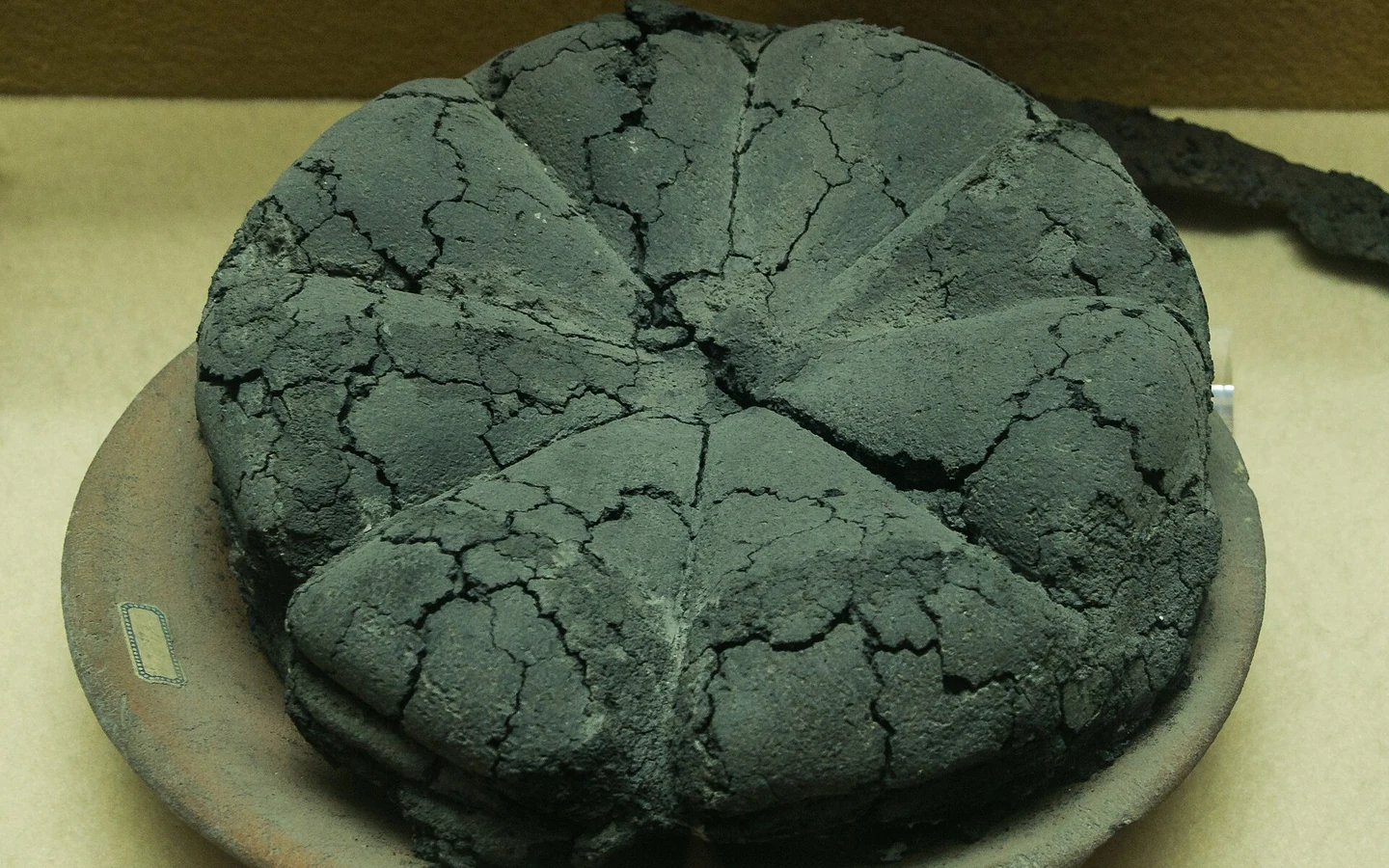
What the catalogues reveal first is an absence. Bread is organic, soft, and eaten. It does not survive except in unusual conditions. So collections hold almost everything except loaves, and the categories they do hold tell you what mattered enough to be made in durable materials.
Models of the process
The most informative single object of this kind is at the Metropolitan Museum of Art: accession 20.3.12, the Model Bakery and Brewery from the Tomb of Meketre, dated to approximately 1981 to 1975 BCE and made of wood, gesso, paint and linen. It entered the collection in 1920.
A funerary model is not a picture of a bakery; it is a three-dimensional statement of what a bakery consisted of, made by people who used one. Bread and beer appear together because they shared grain, equipment and often labour, which is a relationship easy to lose sight of when the two are studied separately.
The same museum holds accession 64.66.10, described as model bread moulds heaped on fire, dated to roughly 2323 to 2150 BCE, in limestone with paint, acquired through the Fletcher Fund in 1964. Moulds heaped on a fire is a specific technique: the mould is preheated, the dough goes in hot, and the bread bakes in a container rather than on a surface.
Figures in the act
Accession 74.51.1755 at the same institution is a terracotta woman baking bread, Cypriot, dated approximately 600 to 480 BCE, part of the Cesnola Collection acquired between 1874 and 1876.
Figurines of this kind are among the few sources for posture and scale of equipment. They also carry a caution: they are representations made for votive or funerary purposes, subject to their own conventions, and should be read as evidence about what was depicted rather than as documentary photographs.
The acquisition dates matter too. An object acquired in the 1870s came through nineteenth-century collecting practice, with the documentation standards of that period. A modern accession from an identified excavation carries a different quality of contextual information, and the catalogue entry is where that difference becomes visible.
Tools with a liturgical or legal function
Some bread objects survive because they were not used on bread every day. The Victoria and Albert Museum holds museum number 1204:1-1905, a communion wafer stamp, dated 1877, produced in Greece, in incised wood.
Objects of this class impress a design on dough before baking, and because their function is symbolic they were made carefully, kept, and eventually collected. The same museum holds bread stamps of secular type, numbers 661-1893 and 662-1893, described as nineteenth century, produced in Algeria, in carved wood.
The measuring instruments
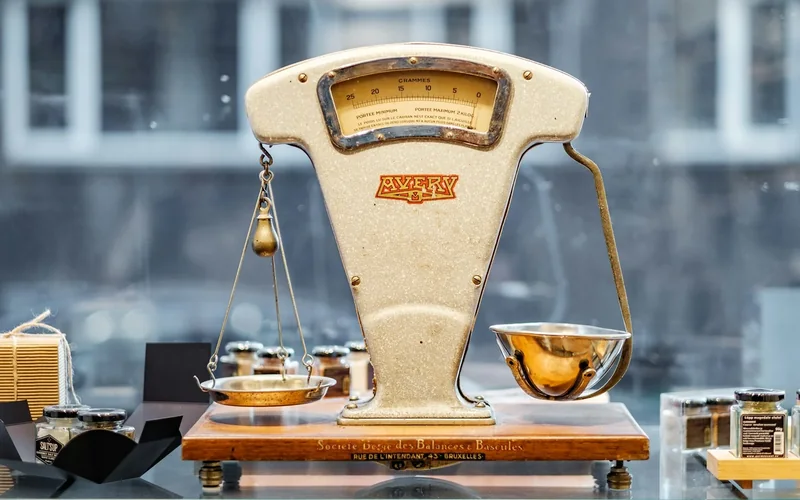
The most revealing category for anyone interested in bread as an economic commodity sits in the Science Museum Group collection, which returns bread-related objects including a domestic bread oven dated 1855 to 1865, a bread gauge dated 1931 to 1940, a portable bread scale dated 1915 to 1925, an English steelyard for weighing loaves of bread dated 1780 to 1799, and an item described as Egyptian sacred bread dated 1800 to 1899.
A steelyard for weighing loaves is not a baking tool. It is an enforcement tool. Its existence in the late eighteenth century is physical evidence that loaf weight was checked, which is the practical end of the bread regulation that survives separately as written record. A bread gauge from the 1930s tells the same story in a later idiom.
That last entry, Egyptian sacred bread with a nineteenth-century date range, is a reminder to read catalogue dates carefully. The date given is the date attributed to the object as catalogued, and for material collected in the nineteenth century the attribution may reflect nineteenth-century assumptions.
How to use these collections yourself
Four practical notes, learned from assembling the above.
Search collection databases directly rather than relying on secondary write-ups. Most large museums now expose their catalogues, several with open data programmes, and the catalogue entry is the citable unit.
Cite the accession number, not just the museum. An accession number is stable and unambiguous; an object title is neither. Two objects with almost identical titles in the same collection are routine.
Read the acquisition line. It tells you how the object arrived, which bears directly on what contextual information exists. Gift, bequest, purchase fund and excavation each imply a different documentary trail.
And treat the recorded date as the institution's current attribution rather than as a fact about the object. Attributions are revised. A date given as a range, particularly a wide one, is the catalogue signalling uncertainty rather than being vague.
Where the gaps are
Two categories are conspicuously thin in what I could reach, and the thinness is informative.
Working bakery equipment from before the industrial period is scarce. Ovens were structures rather than objects, built into buildings and demolished with them, which is why the Science Museum Group's domestic bread oven dated 1855 to 1865 is notable rather than typical. Peels, troughs and baskets were wooden, used until they failed, and burned.
Commercial marking tools are similarly absent. Stamps used to identify a baker or a guild are frequently described in accounts of regulated urban baking, but I could not locate a catalogued example with an accession number. Whether that reflects survival, collecting priorities, or the limits of my search is not something the catalogues themselves can settle.
What the absence teaches
The overall shape of what survives is itself a finding. There are moulds but few loaves, models of bakeries but no bakeries, stamps for marking bread but rarely the marked bread. Every category represents a durable object made to act on something perishable.
This is worth remembering whenever a claim is made about how bread was made in a particular period. The evidence base is mostly indirect: tools, containers, images, weights and written rules. Reconstructing the loaf from them is legitimate inference, and it is inference, which the honest accounts say plainly and the confident ones do not.