The case for a baking steel over a baking stone is usually made on conductivity, and the numbers do look decisive. Engineering reference tables give carbon steel at 0.5 per cent carbon a thermal conductivity of 54 watts per metre kelvin, cast iron 52, wrought iron 59, and stainless 304 a much lower 14.4. Firebrick comes in at 0.47 at room temperature, rising to around 1.4 for fire-clay brick at 500 degrees Celsius. Granite runs 1.7 to 4.0.
So steel conducts heat roughly a hundred times better than firebrick at room temperature and perhaps forty times better at working temperature. That looks like the end of the argument. It is not, for two reasons.
Conductivity is the wrong figure for contact heating
Thermal conductivity describes how fast heat moves through a material in a steady state. What happens when cold dough lands on a hot surface is not a steady state. It is a transient contact problem, and the property that governs it is thermal effusivity, the square root of conductivity times density times specific heat capacity.
Effusivity describes how readily a surface can supply heat to something touching it. It combines conductivity with the material's ability to store heat, which is why a dense metal and a porous refractory behave differently even beyond their conductivity gap.
Using the reference figures, steel has a specific heat capacity of about 0.49 kilojoules per kilogram kelvin against firebrick's 1.05, while cast iron's density of 7.0 to 7.4 grams per cubic centimetre is roughly three to four times firebrick's 1.8 to 2.2. Working the effusivity out gives approximately 1.35 times ten to the fourth for cast iron against roughly 9.9 times ten to the second for firebrick, in the standard units of joules per square metre per kelvin per root second.
That is a ratio of about thirteen or fourteen, not one hundred. The calculation is mine, from published property values rather than from a study, and should be treated as an order-of-magnitude estimate. But the direction of the correction matters: steel's real advantage in contact heating is roughly an order of magnitude, not two.
Thermal diffusivity, the other combination, tells a different part of the story. It comes out around 1.5 times ten to the minus five square metres per second for cast iron against 2.2 times ten to the minus seven for firebrick, a factor of about sixty-five. High diffusivity means steel equilibrates quickly, which is why a steel plate recovers its temperature faster between bakes and also why it loses surface temperature faster when loaded.
The ceiling that limits both
The second reason conductivity is not decisive is more fundamental, and it is measured rather than calculated.
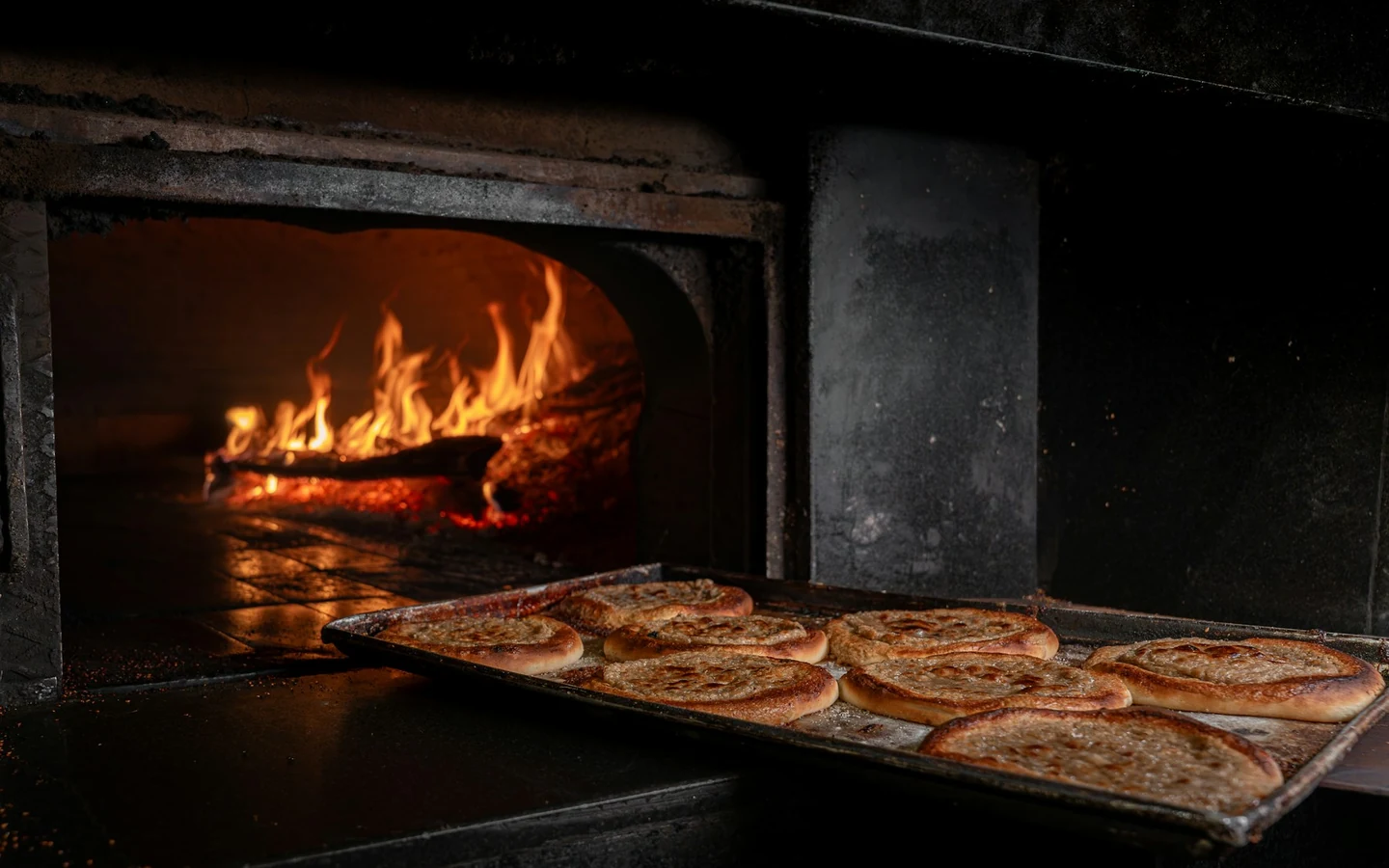
A 2023 study of baking on a wood-fired oven floor recorded the floor at 439 plus or minus 3 degrees Celsius. The dough base, on that same floor, reached a maximum of 100 plus or minus 9 degrees. The study attributes the gap to two intervening layers: trapped air between the dough and the surface, and a layer of water vapour escaping from the dough.
That is a floor 339 degrees hotter than the base it is heating, and the base still stops at the boiling point of water. Heat arriving is consumed by evaporation rather than raising temperature.
The practical implication is uncomfortable for the effusivity argument. If the base temperature is capped near 100 degrees by a phase change, then the surface material determines how quickly that cap is reached and how much water is driven off per unit time, but not how hot the base gets. Steel gets you there faster. It does not get you anywhere else.
Where the surface does matter
Two things follow from the deck being the largest term in the heat budget.
A 2020 review of oven heat transfer reports conduction accounting for 40 per cent of total heat transfer in a commercial deck oven, against radiation at 30 and convection at 15. It also notes that substituting a radiant heat source reduces the conduction share by around 20 percentage points.
So in an oven where bread sits on a hot mass, the mass supplies more heat than anything else. That justifies caring about the surface, even with the base temperature capped, because the rate of energy delivery affects how fast the crust forms, how much water leaves early, and how much of the oven spring window is spent below setting temperature.
It also means the choice matters more in some ovens than others. In a strongly radiant oven, conduction's share falls and the baking surface becomes correspondingly less important.
What has not been compared
The obvious study, baking identical loaves on steel and on stone in the same oven and measuring base colour, crust thickness and volume, does not appear in accessible literature. Searches of the biomedical and food science databases return recipe studies and paywalled pizza heat transfer papers, not a direct controlled comparison.
That is a genuine gap. Everything above is thermal physics plus one measurement of the base temperature ceiling. It supports statements about mechanism and about the direction of differences. It does not support a quantitative claim that a steel gives, say, fifteen per cent more volume or a specific increase in base browning.
What to take from this
If you already own a stone, the case for replacing it with steel is weaker than the conductivity numbers suggest. The effusivity ratio is around thirteen rather than a hundred, and the base temperature is capped by evaporation either way.
Steel's practical advantages are faster recovery between loads, thanks to that sixty-five-fold diffusivity ratio, and a faster approach to the base temperature ceiling. Both matter more when baking several items in succession or when the item is thin and bakes quickly.
Stone's advantages are the mirror image: it holds surface temperature better under load because it equilibrates slowly, and its higher specific heat per kilogram means a given mass stores more energy.
And mass matters in either material. A thin plate of anything, however conductive, has less stored energy to give up than a thick one, which is the variable most often ignored in the argument.