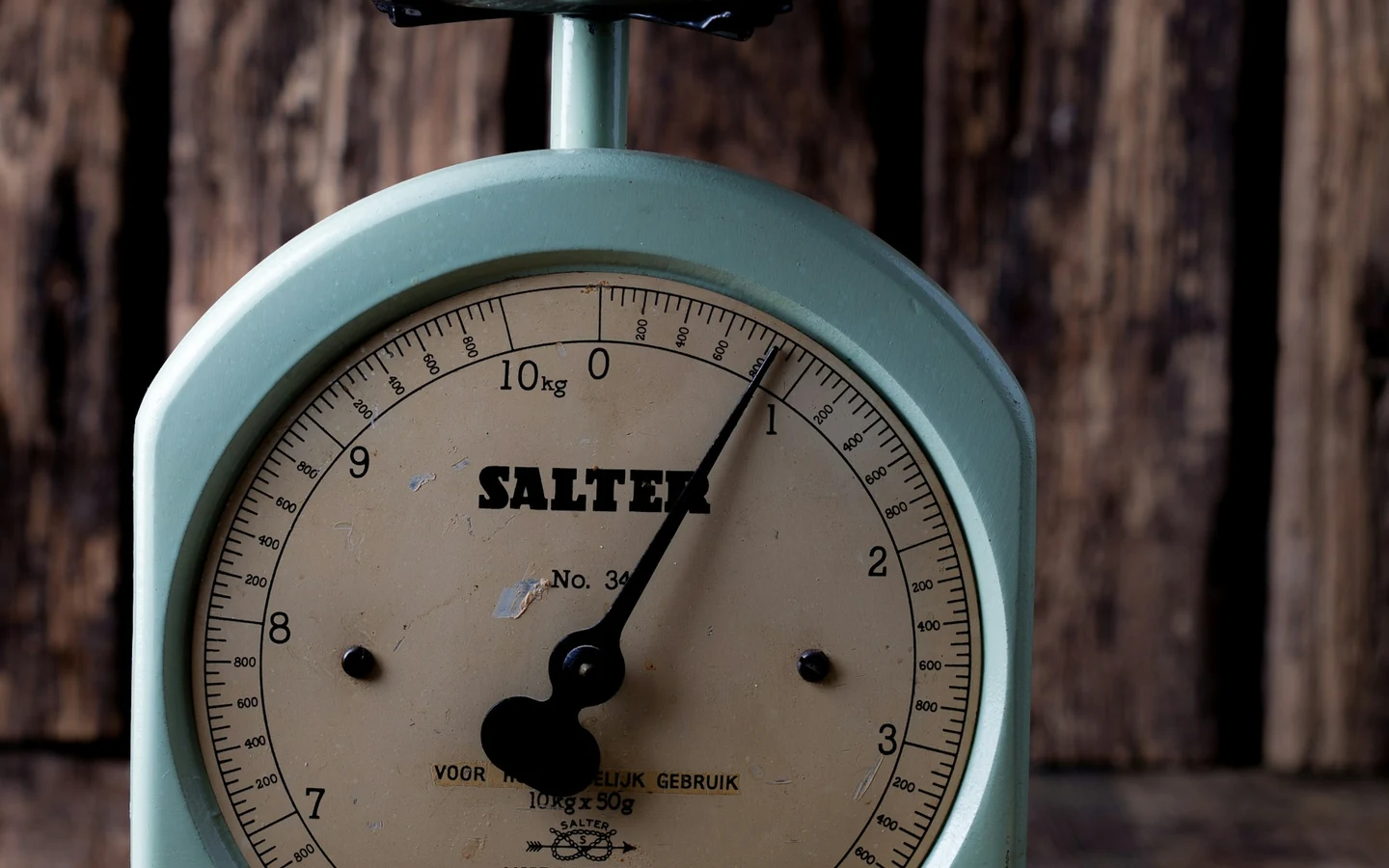
Baking has become a weighing and measuring craft, which makes the accuracy of two instruments worth understanding: the scale and the thermometer. Both are covered by serious metrological standards. Neither of the domestic versions is actually governed by them.
How weighing tolerances are structured
The international recommendation for non-automatic weighing instruments, OIML R 76-1, organises instruments into four accuracy classes. Class I, special, requires a verification scale interval of at least 0.001 grams with at least 50,000 intervals and a minimum capacity of 100 intervals. Class II, high, permits intervals from 0.001 to 0.05 grams with 100 to 100,000 intervals, or intervals of 0.1 grams and above with 5,000 to 100,000. Class III, medium, covers intervals from 0.1 to 2 grams with 100 to 10,000 intervals, or 5 grams and above with 500 to 10,000, and sets minimum capacity at 20 intervals. Class IIII, ordinary, allows intervals of 5 grams and above with only 100 to 1,000 intervals.
Where an instrument has no auxiliary indicating device, the verification interval equals the actual scale interval, and the number of intervals is maximum capacity divided by that interval. Intervals below one milligram are outside the scheme.
The tolerances then rise in steps with load rather than as a fixed percentage. For class III on initial verification, permitted error is half an interval up to 500 intervals of load, one interval from 500 to 2,000, and one and a half intervals from 2,000 to 10,000.
The recommendation's own worked example, spanning instruments of 2, 5 and 15 kilograms maximum capacity with intervals of 1, 2 and 10 grams, gives permitted errors of half a gram from zero to 500 grams, one gram above 500 to 2,000, two grams above 2,000 to 4,000, three grams above 4,000 to 5,000, and ten grams above 5,000 to 15,000.
There is also a sensitivity requirement that is quietly demanding: for class III and IIII instruments up to 30 kilograms capacity, adding a weight equal to the permitted error at that load must produce a permanent displacement of the indicating element of at least two millimetres.
Why none of this binds a kitchen scale
A typical kitchen scale reads to one gram with a capacity of three to five kilograms. That gives 3,000 to 5,000 intervals with a one gram interval, which falls inside the class III ranges. So it looks like a class III instrument, and manufacturers sometimes say so.
That inference is mine, not the standard's, and it comes with a large caveat. OIML R 76 applies to instruments used in trade, and the United States equivalent, NIST Handbook 44, states its scope as commercial weighing and measuring equipment. Handbook 44 is in its 2026 edition, adopted by the 109th National Conference on Weights and Measures, with a lineage back to a first edition in 1949.
Neither instrument governs a scale sold for household use. There is no mandatory verification, no legal tolerance, and no inspection regime. A claim of class III compliance on a kitchen scale is a voluntary manufacturer statement.
The practical consequence is worth internalising. Even a genuinely class III instrument is permitted half a gram of error at low loads, and error grows with load. A recipe specifying two grams of salt is operating at or below the resolution the scale is designed for, and there is no external guarantee your particular scale meets even that.
Contact thermometers have documented uncertainties
For temperature, the well-documented case is thermocouples. A NIST report on thermocouple calibration gives expanded uncertainties for comparison calibration: 0.6 degrees Celsius, equivalent to about 5 microvolts, over 800 to 1,100 degrees for one reference type; 1.6 degrees at 1,450; and 2.4 degrees at 1,750.
It also gives upper limits for comparison calibration of base metal thermocouples, the types found in kitchen equipment: 300 degrees for type T, 760 for type J, 1,000 for type E, and 1,100 for types K and N.
Type T's 300-degree limit is relevant, because type T is what the bread baking literature uses. A 2021 modelling study measured dough and crust temperatures with fine-gauge type T thermocouples of 0.8 millimetre diameter, which sit comfortably within their calibrated range at oven temperatures.
I was not able to obtain equivalent uncertainty figures for thermistors or resistance thermometers, which are what most digital probe thermometers actually use. The relevant NIST calibration services page returned an error, and the thermocouple report does not cover them.
Infrared is worst exactly where bakers use it
The instrument most likely to mislead is the infrared thermometer, and the reason is quantified.
A 2013 uncertainty analysis published in Metrologia identifies emissivity as typically the largest single contribution to radiation thermometry uncertainty, and describes how the error scales: increasing with detection wavelength and with the square of temperature, decreasing with the square of emissivity.
That last relationship has an uncomfortable consequence at low temperatures. The paper reports emissivity-only error of 4 per cent at 200 degrees Celsius, falling below 1 per cent above 550 degrees. Bread crust surfaces sit in the range of roughly 150 to 230 degrees. That is the region where emissivity uncertainty contributes most.
The broader uncertainties reported in that review are sobering for anyone treating an infrared reading as a measurement: a combined standard uncertainty of plus or minus 52 degrees below 850 degrees in one study, an expanded uncertainty of plus or minus 25 degrees at a coverage factor of two in another, and total error under 6 per cent across 420 to 757 degrees in a third.
Baking studies use an assumed emissivity of 0.9 for bread surfaces. If the actual surface differs, because it is wetter, glazed, or dusted with flour, the reading shifts accordingly. A 2024 review of infrared thermography in food processing lists four parameters that must be set before measurement: emissivity, ambient temperature, distance, and relative humidity, and notes that atmospheric absorption varies with the last two. Beside a hot oven, humidity and distance are both poorly controlled.
What to do instead
Weigh in the middle of your scale's range where possible, and treat quantities below about five grams as approximate unless you have a scale with a finer interval. Zeroing repeatedly and adding ingredients cumulatively compounds low-load error; weighing small quantities separately does not fix the resolution limit.
Use a contact probe for anything that matters, and prefer a type whose calibrated range covers your use. Type T thermocouples are the reference choice in the baking literature for good reason.
Treat infrared readings as comparative rather than absolute. They are excellent for telling you that one part of a surface is hotter than another, and unreliable for telling you that a crust is at 190 degrees.