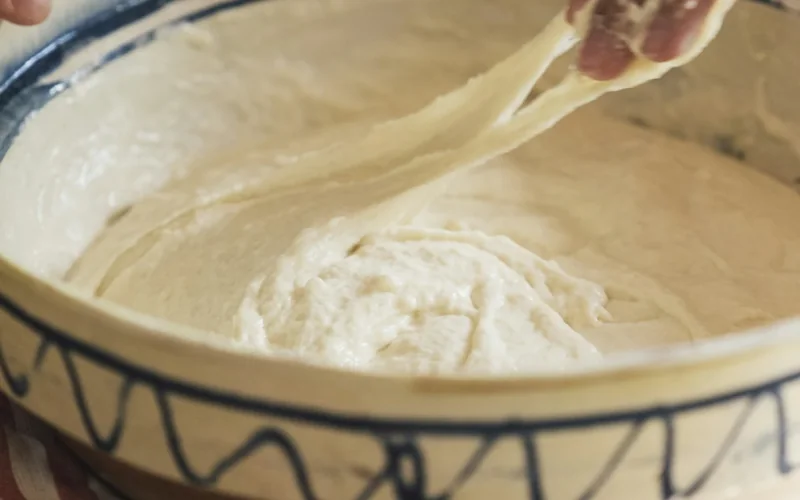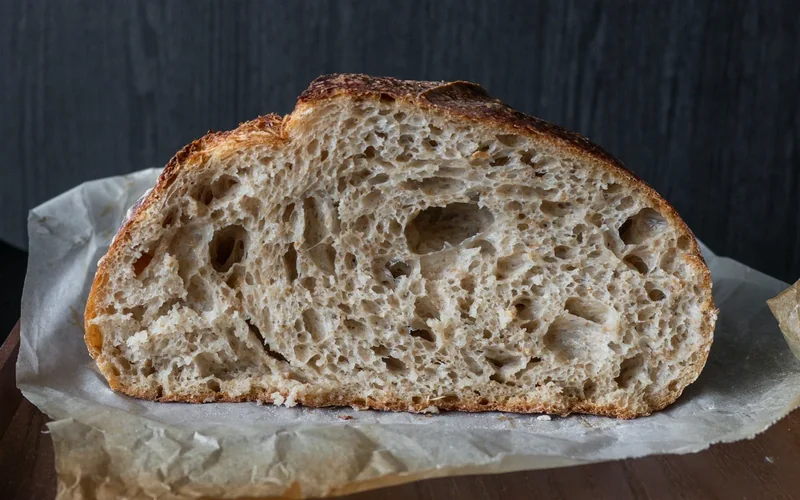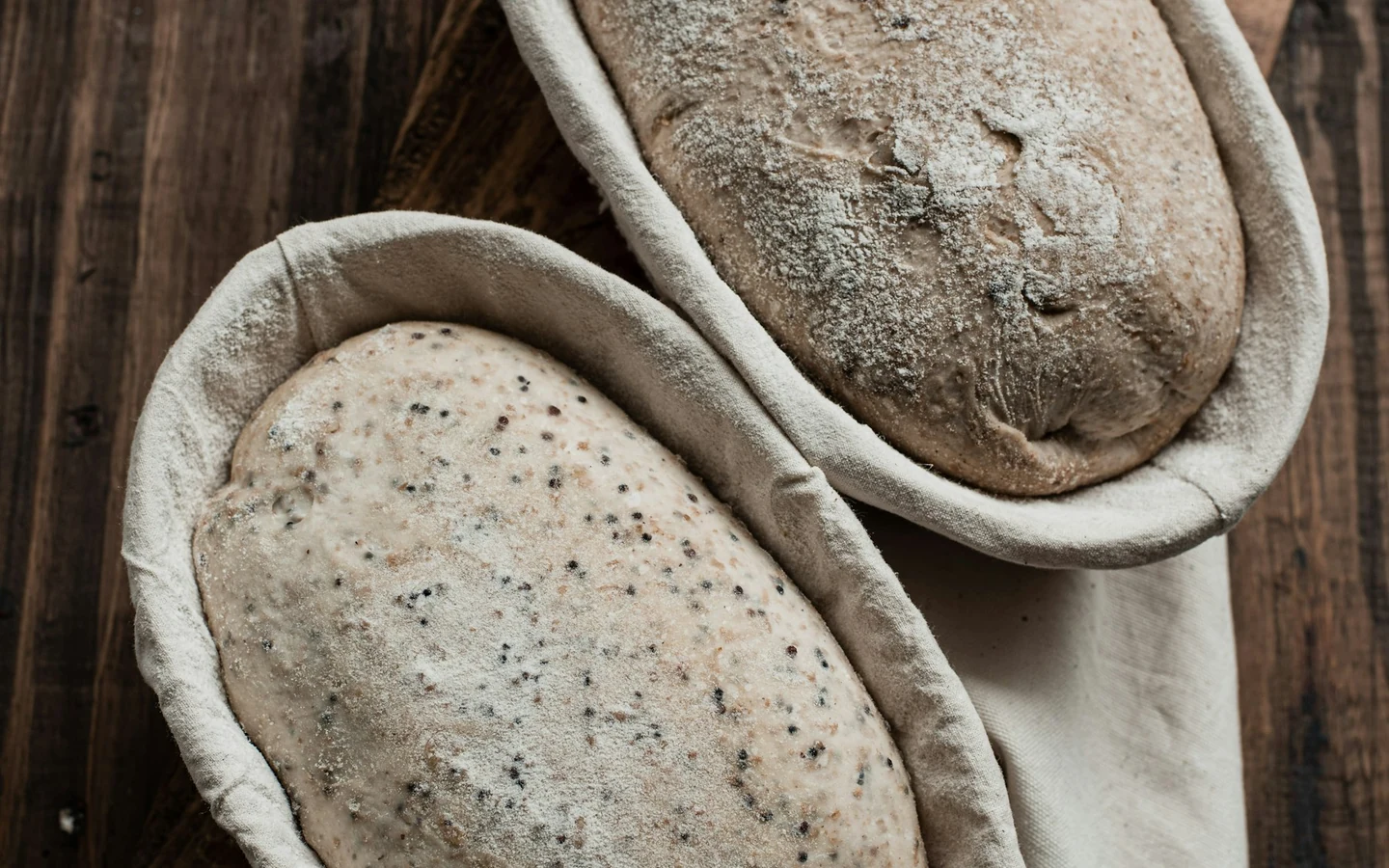
Retarding dough in the refrigerator overnight is standard practice, justified on flavour and on schedule convenience. The available measurements come from a different question, the shelf life of refrigerated dough, and they run out to fourteen days. Read carefully, they tell you a good deal about what the first night does, and they also show why the practice has a limit.
The measurement setup
A 2025 study placed 80 gram dough portions in 250 millilitre measuring cylinders held at 4 degrees Celsius, sampling at days 0, 4, 7, 11 and 14. It compared a control formulation against a modified one.
That design is worth noting before the numbers. It is a dough storage study, using a yeasted formulation with additives, not a comparison of overnight-retarded loaves against same-day ones. The dough is not shaped bread proofing in a basket. Anyone reading these figures as a direct guide to overnight retarding is extrapolating, and I will flag where that extrapolation is safe and where it is not.
Acidification is continuous
Over the fourteen days, pH fell from 6.0 to 4.6.
That is a substantial drop, and it establishes the basic point: fermentation does not stop at 4 degrees, it slows. Organisms continue producing acid, which is why cold retarding is credited with flavour development rather than merely with delay.
For an overnight retard of eight to sixteen hours, the implied change is a small fraction of that 1.4 unit drop. The flavour benefit of an overnight retard is real but modest on this evidence, and it is a beginning rather than a completion.
Gas holding peaks and then fails
The most consequential finding concerns the dough's ability to hold gas.
Peak gas holding was 130.80 millilitres for the modified formulation at day 7 against 127.50 for the control at the same point. But the trajectories differed. The control fermented rapidly from day 4 onward and reached visibly greater volume than the modified dough, then collapsed by day 7, ending with lower volume than its counterpart on the same day.
Rapid fermentation followed by collapse is a recognisable failure mode. Gas production outpaced the dough's structural capacity, cells merged and ruptured, and the accumulated volume was lost.
The relevance to overnight retarding is that the failure is a function of accumulated fermentation rather than of cold as such. A dough that is already well fermented when it goes into the refrigerator has less headroom before this point than one that goes in early.
The dough softens throughout
Instrumental texture tracked steadily downward. Control firmness went from 980.29 plus or minus 12.23 at day 0 to 650.82 plus or minus 29.20 at day 7 and 488.99 plus or minus 30.90 at day 14. The modified dough ran lower throughout: 916.37 plus or minus 56.56, then 546.89 plus or minus 17.44, then 411.92 plus or minus 21.27.
By day 14 both doughs had lost roughly half their initial firmness. Elasticity declined more gently, from 0.94 plus or minus 0.01 to 0.90 plus or minus 0.01 in the control, with the modified dough ending slightly higher at 0.92 plus or minus 0.01.
Resilience showed a non-monotonic pattern in the control, 0.11 at day 0 rising to 0.14 at day 7 and returning to 0.11 by day 14, while the modified dough held between 0.13 and 0.14 throughout.
Adhesion, reported as a negative value, moved dramatically: from minus 1596.74 plus or minus 6.63 at day 0 to minus 594.55 plus or minus 5.81 at day 7, then minus 659.95 plus or minus 39.74 at day 14. Stickiness fell by roughly two thirds in the first week.
Reducing sugars rose across the period in both doughs, with the modified formulation consistently higher. Rising reducing sugars indicate ongoing enzymatic breakdown of starch, which is both a flavour and a browning input and a sign of the structure being progressively degraded.
Why cold is good for dough and bad for bread
There is a contrast here worth making explicit, because the same appliance does opposite things to the two materials.
For baked bread, a 2021 study reports that starch retrogradation occurs above the glass transition temperature, around minus 5 degrees Celsius, and below the melting temperature, around 60, with nucleation and propagation rates peaking near opposite ends of that window. Combining them, retrogradation is faster at refrigerator temperatures, so refrigerating a loaf accelerates firming.
For unbaked dough, the refrigerator slows fermentation without triggering retrogradation, because the starch has not gelatinised yet. There is no crystalline network to reform.
So the rule is not about temperature in the abstract. It is about which material is in the fridge: dough benefits, bread suffers.
A related point closes the loop. A 2024 review notes that the acids produced during fermentation lower dough pH and that this acidic environment inhibits starch reassociation, delaying retrogradation. The acid a retarded dough accumulates therefore buys the finished loaf a slower staling curve, which is a second, less-discussed benefit of the practice.
What the data supports for an overnight retard
Extrapolating carefully from a fourteen-day curve to a twelve-hour window, three statements hold.
Acidification during an overnight retard is real but small relative to what the fridge can eventually produce. Expect flavour development, not transformation.
Softening and reduced stickiness begin immediately and are monotonic in the early period. That matches the common experience that cold dough handles more easily, and the adhesion figures quantify it: a two-thirds reduction in stickiness over the first week is a large change in how a dough behaves under the hands.
And the risk is over-fermentation rather than cold damage. The control dough's collapse at day 7 followed rapid fermentation from day 4, not the temperature itself. A dough that goes into the fridge already well along is on that trajectory, just compressed into a shorter interval.
What the data cannot tell you is the effect on the baked loaf, since no loaves were baked. For volume, crust and flavour of overnight-retarded bread against a same-day control, I found no accessible measurement at all. That is a striking gap given how universal the practice has become.