Fermentation is usually discussed as gas production: feed the yeast, keep it warm, get lift. A 2023 study measuring three wheat varieties on a rheofermentograph, which tracks dough height and carbon dioxide simultaneously, produced a result that reorders those priorities.
That does not make retention a single-number predictor of loaf volume. An independent Food Research International study found that formation rate, the timing of gas loss, and the structural integrity of the dough all affect bread quality, and cautioned against reading rheofermentometer data in isolation.
The measurements
The instrument reports several things at once. Maximum dough height came out at 72.3 plus or minus 5.3 millimetres for one einkorn variety, 73.8 plus or minus 4.8 for a second einkorn, and 63.0 plus or minus 3.6 for the common wheat. Time to reach that peak was 121.8 plus or minus 10.8 minutes, 119.8 plus or minus 20.5 minutes, and 175.0 plus or minus 4.4 minutes respectively.
On gas, total carbon dioxide produced was 1136 plus or minus 89 millilitres for the first einkorn, 1168 plus or minus 107 for the second, and 1713 plus or minus 79 for the common wheat. So the common wheat dough produced roughly half again as much gas as either einkorn.
Then the split. Gas lost was 12 plus or minus 5 millilitres, 15 plus or minus 5, and 193 plus or minus 26. Gas retained was 1124 plus or minus 85, 1154 plus or minus 103, and 1523 plus or minus 85. Expressed as retention coefficients: 99.0 plus or minus 0.4 per cent, 99.3 plus or minus 0.1 per cent, and 88.7 plus or minus 1.6 per cent.
The einkorn doughs held essentially everything they made. The common wheat dough leaked more than one part in nine.
What came out of the oven
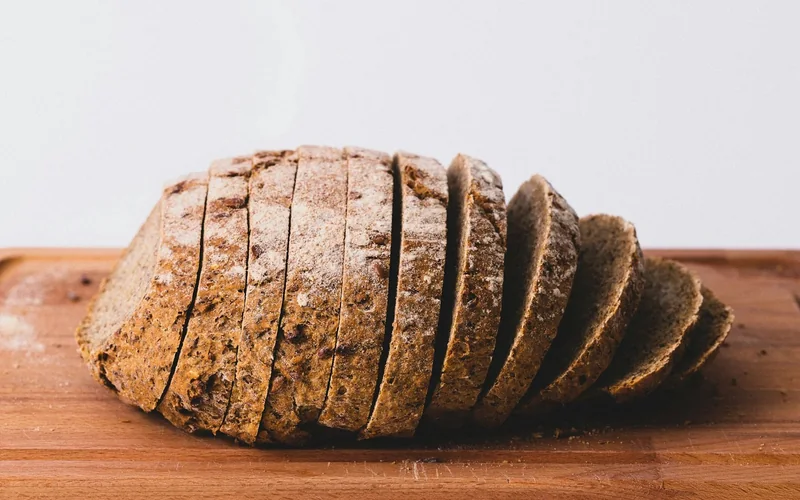
Loaf volumes were 732 cubic centimetres for the first einkorn, 740 for the second, and 671 for the common wheat.
That is the finding worth sitting with. The dough that produced the most gas made the smallest loaf. Not by a trivial margin either: roughly a 9 to 10 per cent volume deficit against doughs that produced a third less gas.
Retained gas is what expands a loaf. Produced gas that escapes into the room does nothing. When the numbers are laid side by side, 1523 millilitres retained against 1124 and 1154 does still favour the common wheat, so retention alone does not fully account for the volume ordering, and the study measured other variables that bear on it. But the direction of the surprise is clear: production and volume are not the same axis.
The composition behind it
The same study measured what the flours were made of, and some of it runs against expectation.
Protein averaged 16.5 grams per 100 grams for the einkorns against 10.5 for the common wheat. Soluble pentosans came in at 1.03 against 0.85 grams per 100 grams. Sedimentation value in the SDS test was 89 millilitres for the einkorns against 66 for the common wheat.
A caution about that last figure. SDS sedimentation correlates strongly with protein quantity as well as with protein quality, so a flour with 16.5 per cent protein will tend to sediment higher than one with 10.5 per cent regardless of how strong its gluten is. Reading a high sedimentation value here as proof of strong gluten would be overreaching, particularly since the wider literature on ancient wheats describes their gluten as abundant but weak.
Farinograph results fill in the handling picture. Water absorption was 52.7 plus or minus 1.5 per cent and 52.4 plus or minus 0.8 for the einkorns against 58.8 plus or minus 0.6 for the common wheat. Development time was 144 plus or minus 15 and 168 plus or minus 23 seconds against 195 plus or minus 107. Stability was 387 plus or minus 226 and 305 plus or minus 122 seconds against 429 plus or minus 234. Softening was 65 plus or minus 20 and 85 plus or minus 15 Brabender units against 56 plus or minus 22.
Note the uncertainties on stability, which are enormous. Plus or minus 226 seconds on a 387 second mean means that particular comparison establishes very little.
Why timing matters as much as quantity
The rheofermentograph gives one more variable that recipe writing usually ignores: how long the dough takes to reach its maximum height. Roughly 120 minutes for the einkorns against 175 for the common wheat.
That is a 55 minute difference in when the dough is at its best, using the same fermentation setup. A schedule calibrated on one flour will either underproof or overproof the other, and the fault will look like a shaping or oven problem when it is neither.
Combined with the retention figures, the operational picture is that each flour has both a peak time and a leak rate, and both need to be respected. A dough that leaks will lose more of what it makes the longer it sits, so a leaky flour is punished twice by a long schedule.
What retention actually depends on
The study measures retention rather than explaining it, so what follows is mechanism from the wider literature rather than from these data.
Gas is held by the dough's continuous phase: the gluten network plus whatever else contributes viscosity and film strength, including soluble pentosans. Cells that rupture or interconnect prematurely vent their gas to the surface. So retention reflects film strength and stability more than it reflects gluten quantity.
That is consistent with these numbers: the lower-protein flour produced more gas, absorbed more water, and retained less. It is not consistent with a simple reading in which more protein means better retention, since these einkorns had more protein and better retention but are elsewhere described as having weaker gluten.
The honest summary is that retention is its own property, measured directly by this instrument, and not reliably predicted from protein content.
What to take from it
If you are choosing between flours, ask about retention behaviour rather than protein alone. A 99 per cent retention coefficient against 88.7 is a material difference in what your fermentation delivers.
If you are adapting a schedule to a new flour, expect the peak to move. A 55 minute shift in time to maximum height is larger than most bakers' tolerance for guesswork.
And if a dough seems to ferment vigorously and still bake flat, gas production is not the variable to increase. More yeast, more time, or a warmer room will produce more gas for the same dough to fail to hold.