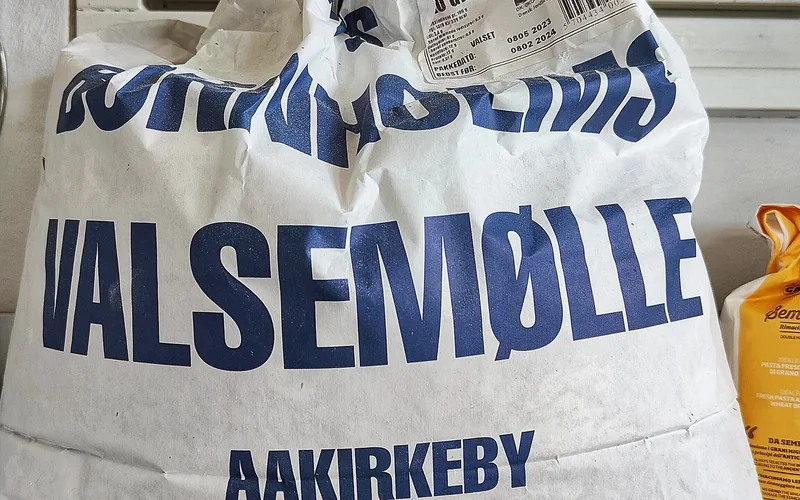
German flour bags carry a number: 405, 812, 997, 1150, 1370. French bags carry a T and a smaller number. Italian bags carry zeros. All three systems are measuring the same thing by the same method, and none of them is measuring what most people assume.
The number is an ash measurement
According to the German millers' association, the type figure is arrived at by burning a flour sample and weighing what will not burn. Organic matter, the starch and protein and fat, is driven off. What remains is mineral matter, reported as milligrams per 100 grams. A flour that leaves about 405 milligrams per 100 grams is designated Type 405. The association gives the ashing temperature as 900 degrees Celsius.
Whole meal flour has no type number, because by definition nothing has been removed and there is nothing for the number to distinguish.
So the number is not a protein figure, not a strength rating, and not a nutritional claim. It is an indirect measurement of composition, and its usefulness rests entirely on one fact: minerals are concentrated in the outer layers of the kernel. A 2023 study of ancient grain flours states that directly, noting that most minerals sit in the outer layers and that these minerals do not ash at the 550 degrees Celsius used in its own determination.
That is the logic of the whole system. More outer layer in the bag means more ash. More ash means a higher number. The number is therefore a proxy for how much of the kernel survived sifting.
A caveat about verifiability
Here an honest limitation has to be stated. The German type designations for wheat, rye and spelt are set by a national standard, DIN 10355, which is a paid document. The equivalent French classification is likewise not freely available as an official text in a form I was able to open and read.
What that means in practice is that the tables of type numbers against ash ranges which circulate widely online, including in the reference works most people reach for, are secondary renderings of a standard rather than the standard itself. They are probably accurate. They are not independently checkable without buying the standard, and different renderings disagree with each other at the edges.
What can be checked is that the French system is in live use with the numbering people cite. A 2024 study in Frontiers in Nutrition works with flours identified as T65, T80 and T150, which confirms the labels are real designations even though the study does not define their ash ranges.
Measured ash in actual rye flours
Where the standards are opaque, published measurements are not.
A 2024 study in Foods compared two commercially typed rye flours and measured their ash directly, reporting 0.724 per cent for the lower-typed flour and 1.028 per cent for the higher one. Note what that means in the type system's own units: roughly 724 and 1,028 milligrams per 100 grams.
A 2026 study of a deliberately low extraction rate rye flour, milled at 55 per cent extraction, reported ash between 0.55 and 1.01 per cent of dry matter, and noted that earlier work on higher extraction rye flours reported 0.75 to 1.52 per cent.
Two things follow. Rye flours in ordinary commerce cover a roughly two-fold range of ash. And measured values often sit slightly below the nominal type figure, which is consistent with type numbers describing an average within a permitted band rather than a target value.
Extraction rate, measured across mill streams
Extraction rate is the more physical concept: the percentage of the incoming grain that ends up in a given flour stream. The clearest published demonstration of how it relates to ash comes from a 2019 study characterising milling fractions.
Refined flour streams in that work had extraction rates between 62.4 and 71.8 per cent, with ash from 0.54 to 0.98 per cent of dry matter. Whole grain and stone-milled flours, at 100 per cent extraction, had ash from 1.76 to 2.41 per cent. The by-product streams sat far higher: fine bran, representing 11.0 to 16.8 per cent of the grain, ran 3.38 to 4.15 per cent ash, and coarse bran, at 13.8 to 26.6 per cent of the grain, reached 6.03 to 7.23 per cent.
Lay those out in order and the relationship is monotonic across the full span. Take two thirds of the kernel and you get about half a per cent ash. Take all of it and you get roughly two per cent. Isolate the outer layers alone and you get six or seven.
That is why a single number can usefully stand in for extraction. Within a grain species, the two quantities track each other closely enough that measuring the easier one tells you about the harder one.
The same idea with different labels
The Italian system makes the extraction logic explicit rather than hiding it behind ash. The 2023 ancient grains study describes sifting degrees of 50 per cent for tipo 00, 72 per cent for tipo 0, 80 per cent for tipo 1, 85 per cent for tipo 2, and 100 per cent for whole meal.
Those are extraction rates stated as such. A tipo 00 flour is half the kernel; a whole meal is all of it. The German and French numbers describe the same continuum from the other end, by measuring what came along rather than by declaring how much was kept.
Why the ashing temperature is worth noticing
One detail undermines any attempt to compare figures across systems too precisely. The German trade description gives 900 degrees Celsius as the ashing temperature. The 2023 ancient grains study used 550 degrees.
Those are not equivalent conditions. Different temperatures drive off different fractions and can leave different residues, which is exactly why a study measuring 1.028 per cent ash in a flour nominally typed above 1,100 is not necessarily evidence that the flour is mislabelled. Before treating a small discrepancy as meaningful, check which method produced each number.
Reading a rye bag
For practical purposes, three statements hold up.
A higher type number means more of the outer kernel is present, which in rye means more of the pentosans and more enzyme activity to manage, not merely a darker colour.
Extraction rate and ash move together within a grain, so either number tells you roughly the same thing, and a bag that gives you one is giving you the other by implication.
And the precise boundary values between adjacent types are the least trustworthy part of the whole system as publicly documented. If a recipe calls for a specific type, the useful substitution question is about extraction and ash, not about matching a number you cannot independently verify.