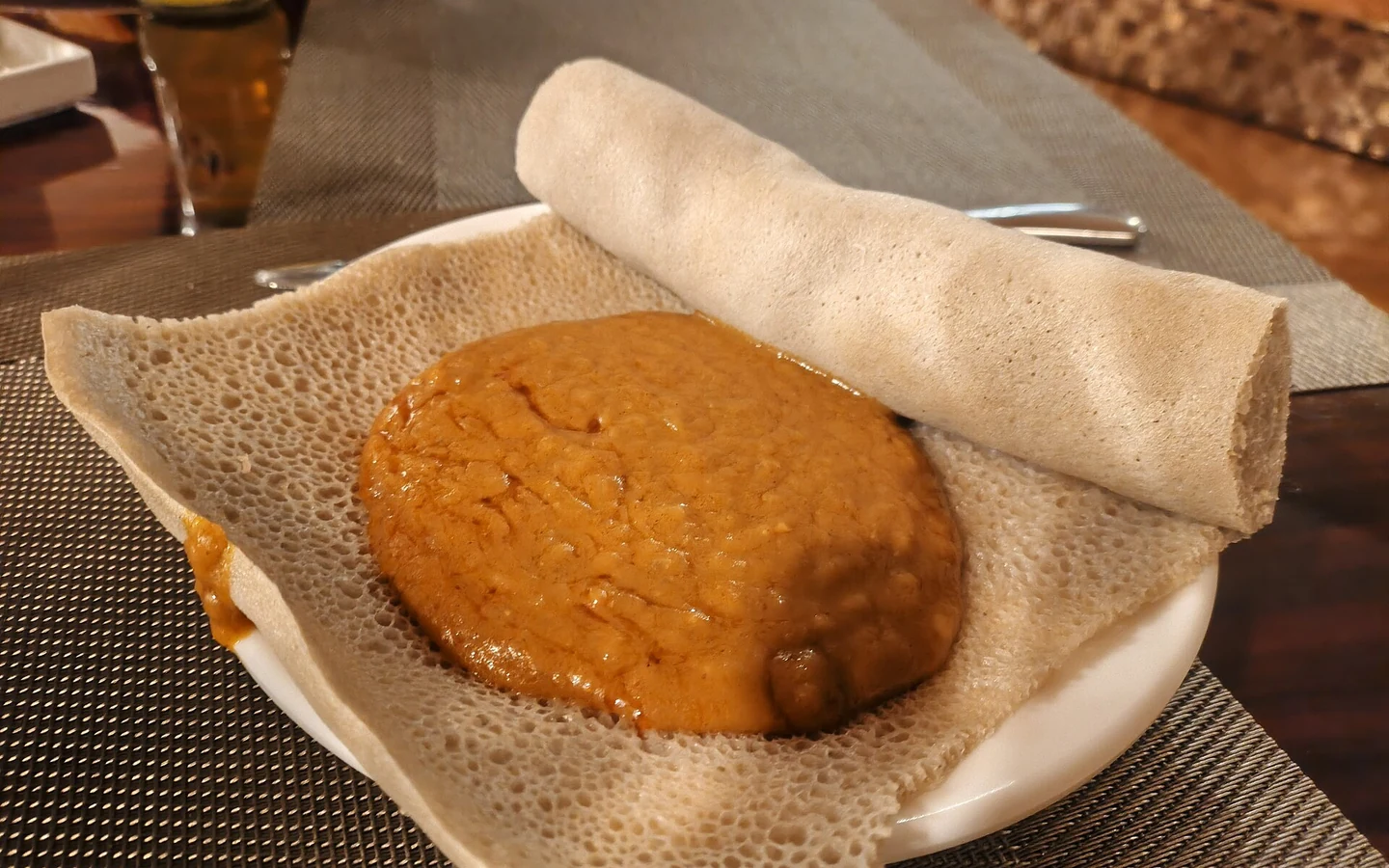
Injera is thin, soft, sour, and covered on one side with open holes that Ethiopian bakers and the research literature alike call eyes. It is usually described as a fermented teff flatbread, which is accurate and almost useless as an explanation. The interesting part is the sequence: a batter is inoculated from the previous batch, left for days, then partly cooked and returned to itself for a short second fermentation. Published studies let us say what each of those steps contributes.
The starter is a liquid, and it is carried over
The batter is mixed in a vessel called a bohaka, made of clay, metal, or wood, and inoculated with ersho, also written irsho. Ersho is not a firm starter dough. It is the clear yellowish liquid that separates and sits on top of a previous fermentation, saved and added to the next batch. After mixing, the batter is left at room temperature to ferment.
Reported durations vary, and the variation is real rather than sloppy. A 2022 review from the University of Gondar gives 24 to 96 hours depending on the temperature reached, and then classifies the product by how long it went: aflegna, fermented only 12 to 24 hours, is thicker, tastes sweet, and browns reddish on its underside; traditional injera is fermented 48 to 72 hours; komtata is over-fermented. A 2025 laboratory study of blended-flour injera used a single fixed protocol, 600 grams of composite flour with one litre of water, 30 millilitres of ersho, five minutes of hand mixing, then 72 hours covered at room temperature.
Near the end of that primary fermentation the clear yellow liquid rises again. Part is kept as the ersho for the next batch. The rest is poured off and discarded; the laboratory study discarded about 100 millilitres before diluting the batter with 200 millilitres of drinking water.
It is worth flagging that the 2022 review states its fermentation windows inconsistently across the same paper, giving 24 to 96, 12 to 72, and 24 to 72 hours in different passages, and contains at least one clear typesetting error in a duration. Its qualitative sequence is well corroborated; its numbers should be read as ranges reported in the literature rather than as a settled protocol.
What the fermentation does to acidity
The chemistry is not subtle. The Frontiers in Microbiology survey of Ethiopian fermented foods measured its injera samples at pH 3.9, with the wider sample set falling between 3.5 and 4.0, and cites earlier work in which batter pH falls from 5.78 to 3.64 over 96 hours of fermentation. The blended-flour study measured finished batters between roughly 3.44 and 3.54.
Acidity also tracks water content in the finished bread. That study cites earlier work on commercial injera in which pH and moisture ran inversely, from pH 3.65 at 60.40 per cent moisture to pH 4.02 at 44.46 per cent. Sourness is not an independent dial; it moves with how long the batter sat, how much ersho went in, whether the surface liquid was poured off, and which flours were used.
Who is actually doing the work
Sequencing has revised the older culture-based picture. The Frontiers study found injera samples strikingly low in species richness and diversity, dominated by the genera Lactobacillus and Limosilactobacillus, principally Lactobacillus pontis and Lactobacillus panis, with Levilactobacillus and Companilactobacillus as minor members. It also isolated four Acetobacter strains, which matters for flavour: the organic acid profile was dominated by acetic acid, with lactic acid second. Earlier culture-dependent studies had identified Pediococcus pentosaceus, Limosilactobacillus fermentum and Lactiplantibacillus plantarum, but this survey detected neither Pediococcus nor Leuconostoc.
Yeasts are not incidental. Saccharomyces cerevisiae, Candida humilis and Pichia fermentans are all reported as playing key roles. The 2022 review, drawing on earlier work, describes a succession: Candida guilliermondii isolated from fermenting teff hydrolyses starch and raises reducing sugar concentration early on, yeasts become dominant in the liquid layer after about 50 hours once pH has fallen below 5, and Saccharomyces species drive the rise in the second stage. Candida and Pichia are the genera most often recovered from the yellow liquid itself.
The absit step, and why the eyes depend on it
Here is the part that has no equivalent in a wheat bread. Roughly 10 per cent of the fermented batter is taken out, mixed with three parts water, and boiled. The resulting paste, absit, is cooled and stirred back into the main batter, which then goes through a second fermentation lasting about one and a half to two hours.
The review is direct about the consequence: injera made without absit tends to be powdery and to have fewer of the eyes. Absit improves texture, consistency, the rise of the batter, and the gas-producing process. And the eyes are not a cosmetic detail. The number of larger pits on the upper surface is what determines whether a given injera reads as good, both to bakers and to the people buying it.
The mechanism is consistent with what boiling does to starch. Cooking a fraction of the batter gelatinises its starch, which thickens the whole mixture once returned. A thicker batter holds the gas that the reactivated yeasts and bacteria produce long enough for bubbles to travel to the surface and set there as open eyes, rather than escaping through a batter too slack to retain them.
The griddle finishes it, and ends the fermentation
Each injera is cooked on a large hot plate called a mitad for two to three minutes, effectively steamed under its own moisture. Baking happens above 100 degrees Celsius, which, as the Frontiers authors note, kills most of the microorganisms present in the batter. Some of the taxa recovered by sequencing from finished injera are therefore attributable to contact after baking rather than to survivors of the bake.
That has a practical implication. Whatever the fermentation contributed, it contributed before the batter met the plate: acid, aroma compounds, gas, and a modified starch and protein structure. Nothing about the finished bread is a live culture.
Reading a piece of injera
Given all of that, a few features become legible. Pronounced sourness points to a long fermentation, a generous ersho dose, or a wetter batter. Dense, closed, slightly powdery injera with few eyes points to a missing or inadequate absit step. A sweet, thicker piece browned underneath is not a failed injera but aflegna, a recognised short-fermentation product with its own name.
What none of this settles is which flour was used. Teff is the reference grain and the one most households prefer, but sorghum, maize, wheat and barley all appear in injera, and the blended-flour literature exists precisely because substitution is common. The fermentation sequence described above is what makes it injera. The grain is a separate question.