A tandoor looks like the simplest oven imaginable: a clay cylinder, a fire at the bottom, dough pressed onto the inside wall. That simplicity hides an unusual heat regime, and the published measurements point somewhere counterintuitive. In a tandoor, the wall does most of the cooking, and in naan the main lift comes from steam rather than from the yeast.
Where the heat actually comes from
The most useful measurement here is old. In 1995, researchers at India's Central Food Technological Research Institute published an analysis of heat transfer modes in a tandoor oven in the Journal of Food Engineering, working with roti as the test product. They derived expressions for the heat absorbed by the roti and the heat transferred to it, and measured the product's thermal conductivity and emissivity in order to close the sums.
Their conclusion was that conduction and radiation from the refractory oven wall dominate, at approximately 51 per cent and 44 per cent respectively. Together those two paths account for roughly 95 per cent of the heat reaching the bread. Convection from the hot gases inside the cavity, which is what most home bakers implicitly assume an oven does, is the small remainder.
They also reported that conduction contributes more to product quality than the other modes. That is a separate claim from the energy accounting, and it is the one with the most practical weight: the moment of contact between dough and wall is doing the work that defines the bread.
This is why a tandoor cannot be simulated by turning a domestic oven up. A conventional oven heats mostly by convection and by radiation from elements that are far from the food. Slapping dough onto a mass of hot clay replaces both with direct contact against a surface holding a great deal of stored energy.
The temperature question, handled carefully
Numbers for tandoor temperature circulate freely and are usually stated as if universal. They should not be.
The measurement I can point to comes from a 2013 master's thesis at South Dakota State University, which built a naan process around a high-temperature tandoor. It reports that the oven generates heat in excess of 700 degrees Fahrenheit, and that once fully heated the cylindrical cavity holds a gradient, 588.5 degrees at the bottom rising to 722.5 degrees at the top. Converting those figures gives roughly 309 to 384 degrees Celsius, with 700 Fahrenheit equivalent to about 371 Celsius.
Two caveats matter. This is one oven measured in one study at dissertation level, not a survey of tandoors, and real tandoors vary widely in depth, mouth size, wall thickness, and fuel. And the gradient is the more interesting finding than the peak: a vertical difference of well over a hundred Fahrenheit degrees between floor and top means that where the dough is placed on the wall changes how it bakes. A baker working such an oven is choosing a temperature by choosing a height.
Naan is leavened, but not by its yeast
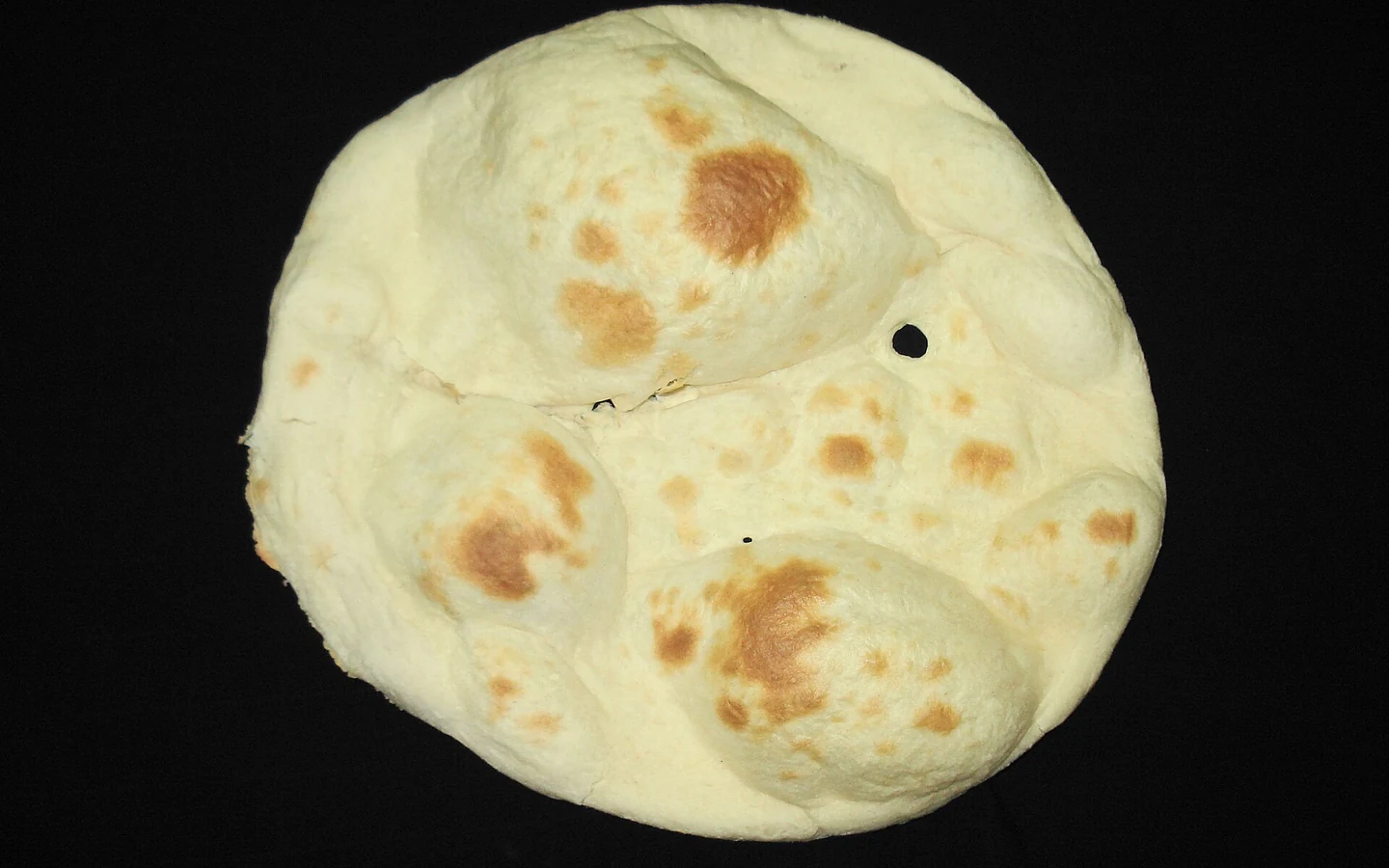
The same thesis is unusually clear on a point that most naan writing gets backwards. Naan is described as a leavened flatbread, and yeast fermentation is credited with its flavour. But on lift, the finding is explicit: the steam formed in the high-temperature tandoor is the primary leavening agent.
The physics is straightforward once stated. The dough goes onto the wall as a thin sheet, formed in the thesis into a teardrop round 2 to 3 millimetres thick and 150 to 180 millimetres across. At wall temperatures in the range above, water in that thin sheet flashes to steam almost immediately. The steam has nowhere to go but into the dough's own structure, which inflates and then sets as the surfaces dry. Gas that the yeast produced during bulk fermentation is a minor contributor by comparison, because there is very little dough and very little time.
That reframes what fermentation is for in this bread. It is a flavour and dough-handling step, not a volume step. It also explains why naan collapses and toughens as it cools in a way that an oven-spring bread does not: the structure was inflated by vapour that condenses.
The archaeological question, and its limits
Because a clay oven is durable, tandoor-like structures turn up in excavation, and the temptation to draw a straight line from them to modern naan is strong. The evidence supports something narrower.
At Kalibangan, a Harappan site in Rajasthan, both underground and overground mud ovens have been found inside houses. The published description, quoted from Madhu Bala's chapter in a 2004 Marg Publications volume on Indus civilisation sites, states that these ovens closely resemble the present-day tandoors of the Rajasthan and Punjab region. The underground type has a slight overhang near the mouth; the overground type has a bridged side opening for feeding fuel and was periodically replastered with mud.
On what was cooked in them, the source is careful, and so should any account drawing on it be: the ovens were perhaps used for baking bread, as the Kalibangan residents were mainly wheat eaters. That is an inference from diet, not a residue analysis. The site itself is substantial, with a citadel roughly 240 by 120 metres, walls 3 to 7 metres thick at the base, and mud bricks in a 4:2:1 ratio, so the domestic context is well documented even where the culinary use is not.
The honest summary is that the oven form is very old in this region and the resemblance is close, while the specific bread is not attested. Note also that this material reaches me through a website quoting a scholarly volume rather than through the excavation report itself, which is a further reason to treat it as indicative.
What distinguishes naan from a roti
Two variables separate them, and both follow from the above. Naan is fermented and roti generally is not, which changes flavour and extensibility rather than final volume. And naan is baked against the tandoor wall, while roti is more commonly cooked on a flat plate, which changes which heat path dominates.
The CFTRI study is a useful reminder that even roti baked in a tandoor receives its heat mostly by conduction and radiation from the wall. The tandoor imposes its regime on whatever is put into it. What the baker controls is the thickness of the sheet, the moisture in it, and the height on the wall where it lands.
What this means for anyone trying to reproduce it
If steam from the dough's own water is the leavening and wall contact is the dominant heat path, then the substitutions that matter are about thermal mass and contact, not about temperature displayed on a dial. A heavy preheated surface in a domestic oven gets closer to the mechanism than a hotter setting with the bread on a thin tray. Thinner dough with adequate hydration exploits the steam effect; thicker dough defeats it.
And the fermentation still has a job. It just is not the job it is usually credited with.