Sliced bread is so ordinary that its arrival is often told as a neat invention story: one inventor, one machine, one suddenly transformed breakfast. The records support a more useful account. A Smithsonian history places a machine in service at the Chillicothe Baking Company in 1928. A patent document filed that year and issued later describes a mechanical system for slicing a loaf. Together, these sources connect an engineered device to a bakery practice without making the technology itself the whole story.
The Smithsonian's account of the sliced loaf gives a public-history timeline. The patent record for US 1,867,377 is a technical document: it records an application filed in November 1928 and a patent issued in July 1932. Those dates refer to different events. The filing date is not the same as the day a bakery first used a machine, and a patent publication is not a complete history of commercial adoption.
The problem was consistency at speed
Before mechanical slicing, a loaf sold whole and the household cut portions as needed. That arrangement was workable, but the slices varied in thickness and required a knife and time. A bakery machine changed the unit of sale: the loaf could arrive already divided into repeatable portions and wrapped to hold its shape. The engineering problem was not simply to move a blade through bread. It was to do so repeatedly without crushing a soft product or producing a loose pile that was difficult to package.
Rohwedder's patent describes a machine in which multiple cutting elements act across a loaf. Rather than treating a knife as a single moving edge, the document lays out an arrangement of blades and associated structures that guides, supports and separates slices. Patent claims are written to define a technical invention in legal terms. They are not neutral prose about every machine ever made, and they should not be read as proof that no one else had imagined any form of bread slicer.
This distinction matters for attribution. The document identifies Otto Frederick Rohwedder's invention and sets out the claimed mechanism. The museum record anchors an early commercial use at a named bakery. Neither source alone answers every question about earlier prototypes, competing ideas or the exact labor behind manufacturing and installation. A careful history can credit the documented inventor and still avoid reducing a complex adoption story to one person acting alone.
Why the first installation matters
The Smithsonian dates the machine's use at Chillicothe Baking Company to 1928. That gives the story a specific place and commercial setting. A bakery is where an experimental device meets real production: loaves arrive with variation, operators need to keep pace, blades need maintenance, and packaged bread has to survive handling. A machine that works once in a workshop is not automatically a viable production system.
Public histories sometimes call Chillicothe the first bakery to sell sliced bread. The claim is best kept attached to the source that makes it and to the definition of “first.” First commercial installation, first packaged loaf sold in a town, first patent filing and first successful long-running machine are not necessarily identical milestones. The Smithsonian account offers a useful museum chronology, but it is not a complete census of every bakery experiment in the period.
The early machine also faced practical limits. The museum account recounts an earlier installation that did not hold up under heavy use. That episode is a reminder that adoption depends on reliability as much as invention. A slicing system needed to stay aligned, handle production volumes and leave slices intact. Improved operation came through testing in a setting where bread had to be made and sold every day.
Reading a patent as a source
Patent documents have a particular structure. The title gives a short label. The drawings illustrate a proposed arrangement. The description explains components and operation. The claims state what the applicant seeks to protect. A patent is strong evidence for what its text and drawings contain, and for the dates in its record. It is not an independent verification that every claimed advantage worked exactly as described in all conditions.
Rohwedder's document should therefore be read for its mechanical detail. It describes how a loaf can be held and how a set of blades can create a series of slices. It offers evidence of an engineering response to a bakery task. It does not tell us what customers thought, how workers felt about the machine, or what happened to every loaf after leaving the bakery.
The patent's issue date should not be mistaken for the date the idea first existed or the date of a particular bakery sale. The application was filed in 1928 and the patent issued in 1932. A four-year gap is normal enough in patent processing, but it illustrates why historical writing should preserve each date's meaning. “Invented in 1932” would be a poor summary of this record.
Packaging changed the product's journey
Slicing altered more than the moment of cutting. A pre-sliced loaf needed packaging that kept the slices together and limited exposure to air. Packaging also made a standardized product easier to transport and display. This relationship between machine and wrap helps explain why slicing became a commercial system rather than a novelty appliance. The slicing device, bakery workflow, wrapping method and distribution network reinforced each other.
The new format shifted a task from the household to the producer. That could save preparation time for a buyer and make portions more predictable. It could also change how quickly a loaf seemed to stale, because more surface area was exposed once the package was opened. These are practical consequences of slicing, but they should not be exaggerated into a claim that slicing alone transformed the entire bread industry. Flour production, transport, packaging and retail all contributed to modern bread markets.
The famous phrase “the best thing since sliced bread” belongs to a later cultural history, not to the patent's engineering claims. A slogan can show that a product became a shared reference point. It cannot tell us exactly how quickly households adopted it or what every customer valued. The museum's account is useful for connecting the object to that broader memory; the patent is useful for the machine itself.
What the sources leave open
The patent and museum narrative do not provide a full production log for the first years of sliced bread. They do not quantify the effect of the machine on worker hours, bakery output or household consumption. They do not establish that every early machine used the same configuration. Those questions would require additional sources: company records, advertising, trade papers, production accounts, oral histories and surviving machines with documented provenance.
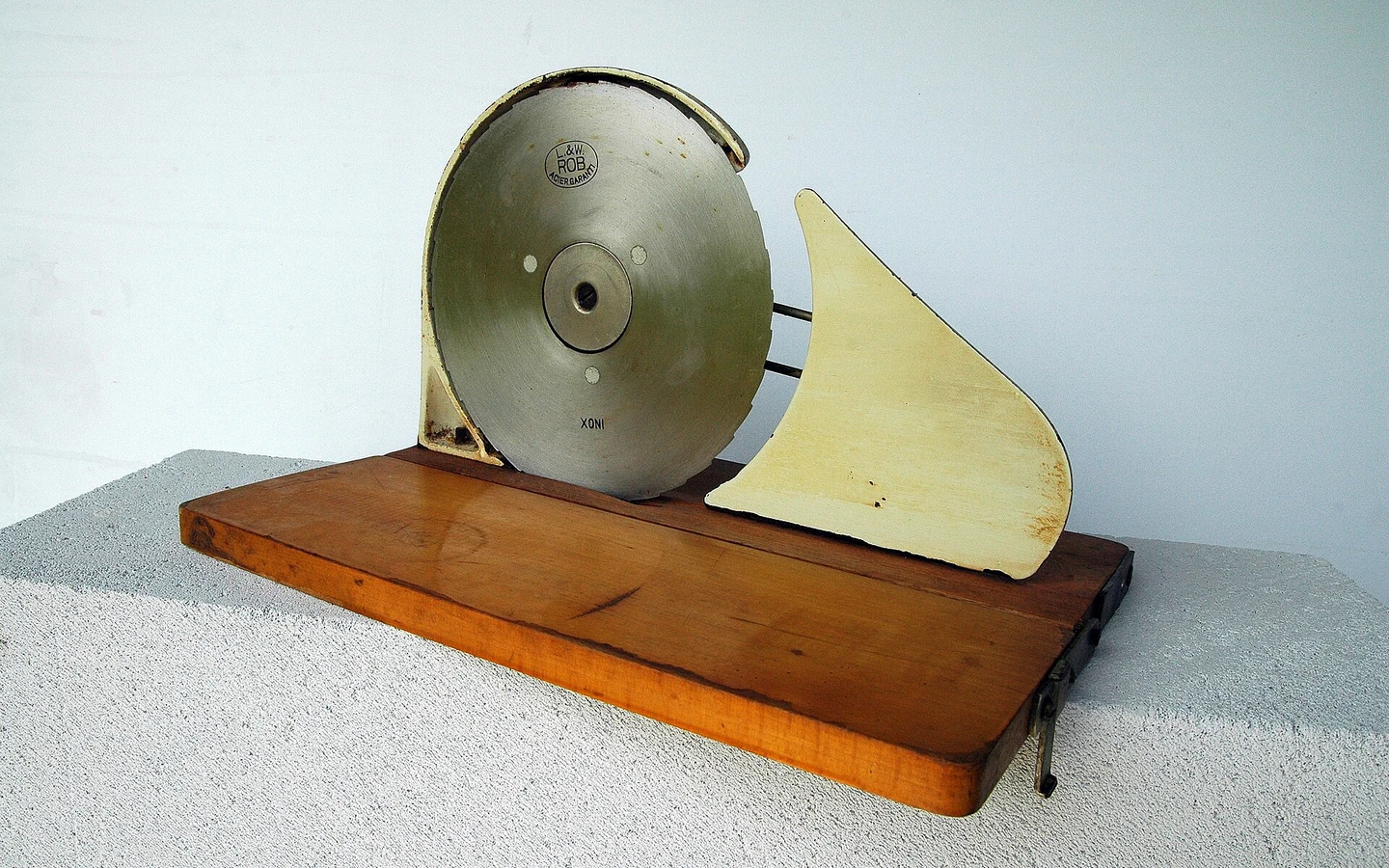
Nor should a surviving machine automatically be treated as the exact model used in the first installation. Museum objects have their own histories of acquisition, restoration and display. The Smithsonian object record for a specific slicer can identify the artifact and its context, but a photograph of a related machine is not proof of how the earliest installation looked.
When checking a photograph of a slicer, establish which machine it shows, when the image was made and how that identification was recorded. Those details allow a reader to connect the object to a patent or installation without treating every bread-slicing machine as the same historical design.
The loaf as a technical and social change
The sliced loaf is a good case study in how a small mechanical operation can reorganize a product. The patent makes the engineering visible: support the loaf, coordinate blades, keep portions aligned. The Smithsonian record places the machine in a bakery and gives the technology a public history. The resulting packaged loaf then changed the way bread could be handled, displayed and used at home.
Keeping those layers separate makes the story stronger. The patent tells us what was claimed. The museum timeline tells us about a documented commercial debut. Later marketing and everyday memory tell us how slicing became a cultural shorthand. None of those sources needs to do every job.
When someone asks who invented sliced bread, the answer can begin with Rohwedder and the patent, then continue with the bakery that put the machine to work and the system that made sliced loaves practical. That answer is less tidy than a slogan. It is also closer to what the record can support.