The argument for a wood-fired oven is thermal mass: a large body of hot masonry that delivers heat steadily and does not lose its temperature when cold dough lands on it. That argument is correct, and one part of it has been measured precisely enough to quote. Other parts, including most of what is claimed about retained-heat baking after the fire goes out, have not.
The measured oven
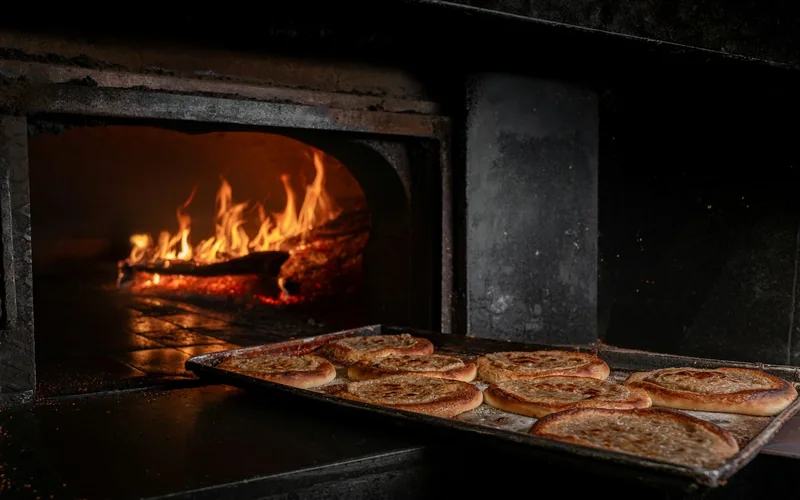
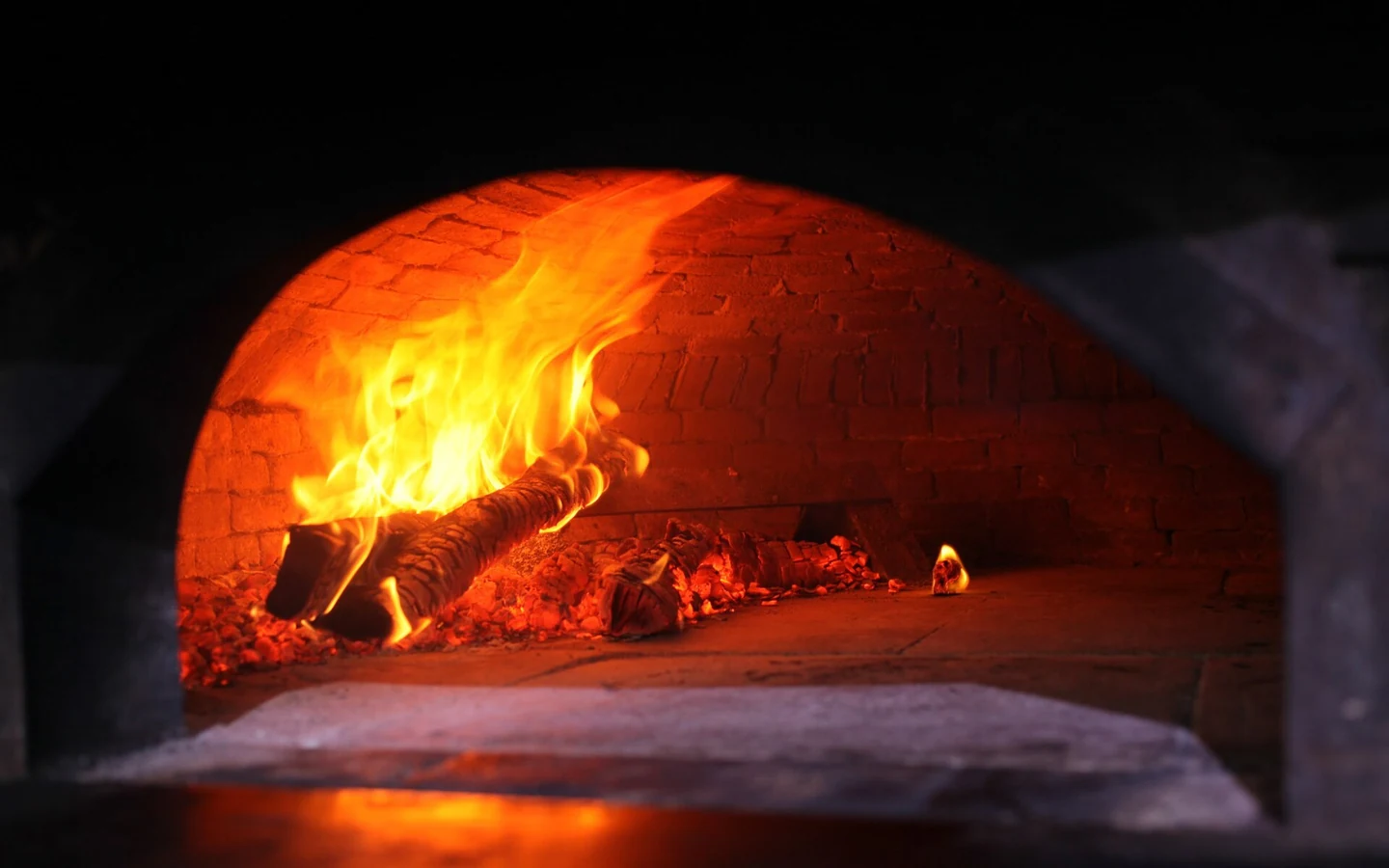
A 2022 characterisation study gives dimensions for traditional wood-fired ovens of this type: floor diameters of 105 to 140 centimetres, vault heights of 40 to 45 centimetres, and mouth openings 45 to 50 centimetres wide by 22 to 25 high. Its own instrumented oven had a cylindrical chamber 90 centimetres across and 20 centimetres high topped by a flattened ellipsoidal vault, with a mouth 44 by 22 centimetres, and walls and floor about 10 centimetres thick.
The steady-state temperatures such ovens are operated at are given as roughly 430 degrees Celsius at the floor and 485 at the vault. Maintaining that quasi-steady condition required feeding oak at 3 to 9 kilograms per hour.
The efficiency figure is the one that surprises people. Thermal efficiency was measured at 13 plus or minus 4 per cent. Around seven eighths of the wood's energy does not end up in the food. Part of the explanation is visible in another measurement from the same study: ambient air at 36.4 degrees Celsius and 20.4 per cent relative humidity was continuously drawn in through the mouth. An oven with a permanent opening is a chimney as well as a chamber.
Where thermal mass actually earns its keep
The clearest demonstration of what stored heat does comes from a 2023 study measuring heat transfer at the dough base. It reports the floor temperature during baking as 439 plus or minus 3 degrees Celsius, and states that temperature decay in the masonry was not measurable over the timescale of a single pizza.
That is the whole case for thermal mass in one sentence. A thin metal surface at 439 degrees would drop sharply the moment wet dough contacted it. Ten centimetres of refractory floor does not, because the energy needed to heat the dough is small relative to the energy stored in the masonry beneath it.
The same study quantified what the dough receives. The initial heating rate at its base was 2.7 plus or minus 0.2 degrees Celsius per second, with a second-order term of minus 0.044 plus or minus 0.005 degrees per second squared, and the base reached 100 plus or minus 9 degrees Celsius after 80 seconds.
Two things follow. The heating rate is high, which is what a hot floor with plenty of stored heat delivers. And it decelerates, which is what the negative second-order term describes: as the base approaches 100 degrees, evaporation begins absorbing energy and the temperature rise flattens.
The ceiling nobody can raise
That 100-degree plateau is the most useful thing in this literature for anyone comparing ovens.
However hot the floor, the dough base cannot exceed the boiling point of the water in it while free water remains. The energy arriving goes into vaporisation rather than into raising temperature. A floor at 439 degrees delivers heat faster than a floor at 300, so the base reaches its plateau sooner, but the plateau itself is set by physics rather than by the oven.
This explains why baking on a very hot surface changes timing dramatically and browning somewhat, but does not produce a fundamentally different base temperature. It also explains why comparisons between baking surfaces are usually comparisons of how quickly they get you to the plateau.
What the masonry properties tell us
Engineering reference tables give firebrick a thermal conductivity of 0.47 watts per metre kelvin at 25 degrees Celsius, rising to around 1.4 for fire-clay brick at 500 degrees. Specific heat capacity is around 1.05 kilojoules per kilogram kelvin, and density 1.8 to 2.2 grams per cubic centimetre.
From those, thermal diffusivity, the ratio of conductivity to the product of density and specific heat, works out to roughly 2.2 times ten to the minus seven square metres per second at room temperature, or about 6.7 times ten to the minus seven using the 500-degree conductivity. That arithmetic is mine rather than a published value, and it should be treated accordingly.
The number is nonetheless informative. Low diffusivity means heat moves through refractory slowly. That is exactly the property wanted in an oven floor: it stores energy and releases it at the surface without conducting it away quickly into the ground. It is also why these ovens take hours to heat through, and why wall thickness is a design decision rather than a detail.
What is not documented
Two gaps deserve stating, because they are where most confident claims about these ovens live.
I found no published measurement of a retained-heat cooling curve: the oven temperature as a function of time after the fire is out and the door closed. The practice of baking a sequence of items down a falling temperature, bread then slower items then drying, is well established in craft tradition, but the temperature decay behind it does not appear to be documented in accessible literature.
Nor did I find a quantitative relationship between wall thickness and heat retention time. It is a straightforward heat conduction problem in principle, and the diffusivity figures above indicate the direction, but the specific answer for a given oven geometry is not something these studies provide.
What this means in practice
Three conclusions rest on measurements rather than tradition.
Thermal mass buys temperature stability, not higher temperature. The 439-degree floor holding to within three degrees during a bake is the benefit; the number itself could be reached by other means.
Fuel efficiency is poor and the mouth is a large part of why. At 13 per cent, a wood-fired oven is not a fuel-efficient way to bake a small number of items, and continuous air ingress through an open mouth is measurable.
And the dough base has a hard ceiling near 100 degrees regardless. Anyone chasing a hotter base is chasing a faster approach to that ceiling, which is a real difference in bake time and crust development, and not a difference in base temperature.