Almost every bread name is a description that anyone may borrow. A handful are legal instruments. Pane di Altamura belongs to the second group: it was entered into the European register of protected designations of origin by Commission Regulation (EC) No 1291/2003 of 18 July 2003, and behind that entry sits a production specification filed by a consortium of local artisan bakers under national file number 5/2000, classified as a bakery product in class 2.4. The specification is unusually specific, and reading it is a short course in what actually determines the character of a loaf.
The grain comes first, and it is named
The dough is made from rimacinato di semola di grano duro: durum wheat semolina, milled and then milled again. The specification does not stop at the species. It names four varieties, appulo, arcangelo, duilio and simeto, and requires that they make up at least 80 per cent of the semolina, alone or in combination. The remaining fraction may come from other varieties, but only ones grown in the same designated area.
The wheat itself has to clear four certified thresholds, all of them measurable rather than descriptive. Test weight must be at least 78 kilograms per hectolitre. Protein, calculated as total nitrogen multiplied by 5.70, must reach 11 per cent of dry matter. Ash must stay below 2.2 per cent of dry matter. Dry gluten must reach 9 per cent of dry matter. For the milled semolina, two further indices apply: a gluten index below 80 and a yellow index of at least 20.
That yellow index is the reason the finished crumb is described in the specification as straw yellow rather than white. It is a property of the grain, carried through milling, not a colouring added at the bench.
Milling is part of the recipe
Most bread specifications treat flour as an input. This one reaches into the mill. Grinding must be done with paired metal rollers of differing diameter and surface roughness, brought progressively closer, turning at around 300 revolutions per minute, and the working temperature must not exceed 40 degrees Celsius.
The stated purpose is mechanical: the friction ruptures most of the cells of the kernel's aleurone layer, which allows oil from the germ to permeate the twice-milled semolina. The temperature ceiling protects that oil from the heat grinding would otherwise generate. The specification also requires that the mills processing this semolina sit inside the designated wheat-growing area, which keeps the grain and its milling in the same place.
The dough, by weight
The fermentation agent is lievito madre, a natural starter that must be built up through at least three refreshments before use, made with water and durum semolina at a quantity equal to 20 per cent of the semolina destined for the final dough.
The final mix is then given as a ratio per 100 kilograms of twice-milled durum semolina: 20 kilograms of that natural starter, 2 kilograms of sea salt, and roughly 60 litres of water at 18 to 20 degrees Celsius. Mixing runs for at least 20 minutes in a machine with plunging arms. The water must be drinking water from the local mains, certified by the water authority.
Three rest stages follow, each with its own minimum. After mixing, the dough is covered with cotton cloth of a certain thickness so that fermentation proceeds at an even temperature, and rests at least 90 minutes. It is then weighed and shaped by hand, so that the dough is drawn up into its own natural outer skin, and held 30 minutes. A second hand shaping follows, then at least 15 more minutes.
The oven, and the myth about wood
Here the specification is more permissive than the folklore around it. On the general question of equipment, it says ovens should preferably be fired by wood or gas, indirectly or directly, subject to the exemptions the law allows. Preferably is the operative word: a wood fire is not mandatory.
One wood requirement is absolute, though, and it is narrower than usually reported. Where a directly heated oven is used, it must be fired with wood of the oak genus. If the heating is indirect, that clause does not bite.
The bake itself is prescribed. The oven must reach 250 degrees Celsius. Immediately before loading, the shaped loaf is turned over and pressed lightly on one side by hand. The first 15 minutes are baked with the oven mouth open; the mouth is then closed and the loaf bakes a further 45 minutes. Before unloading, the mouth is opened again for at least five minutes to let steam escape, which the specification links directly to drying the crust so that it becomes crisp. The loaves come out onto wooden boards.
What the finished loaf has to be
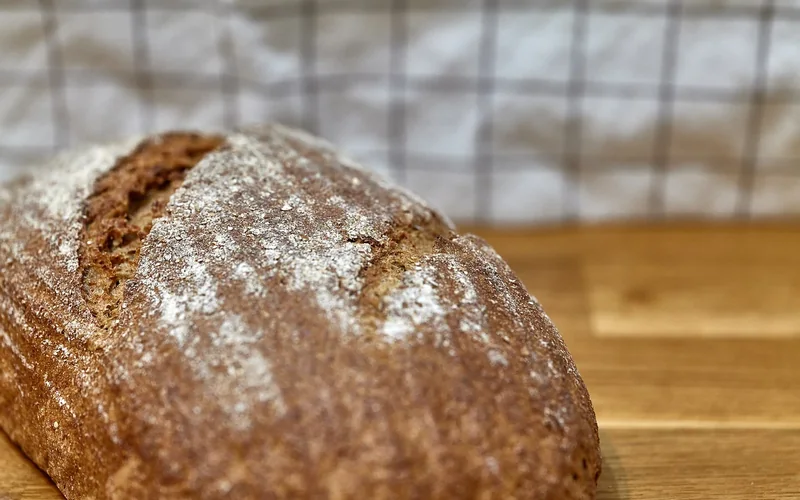
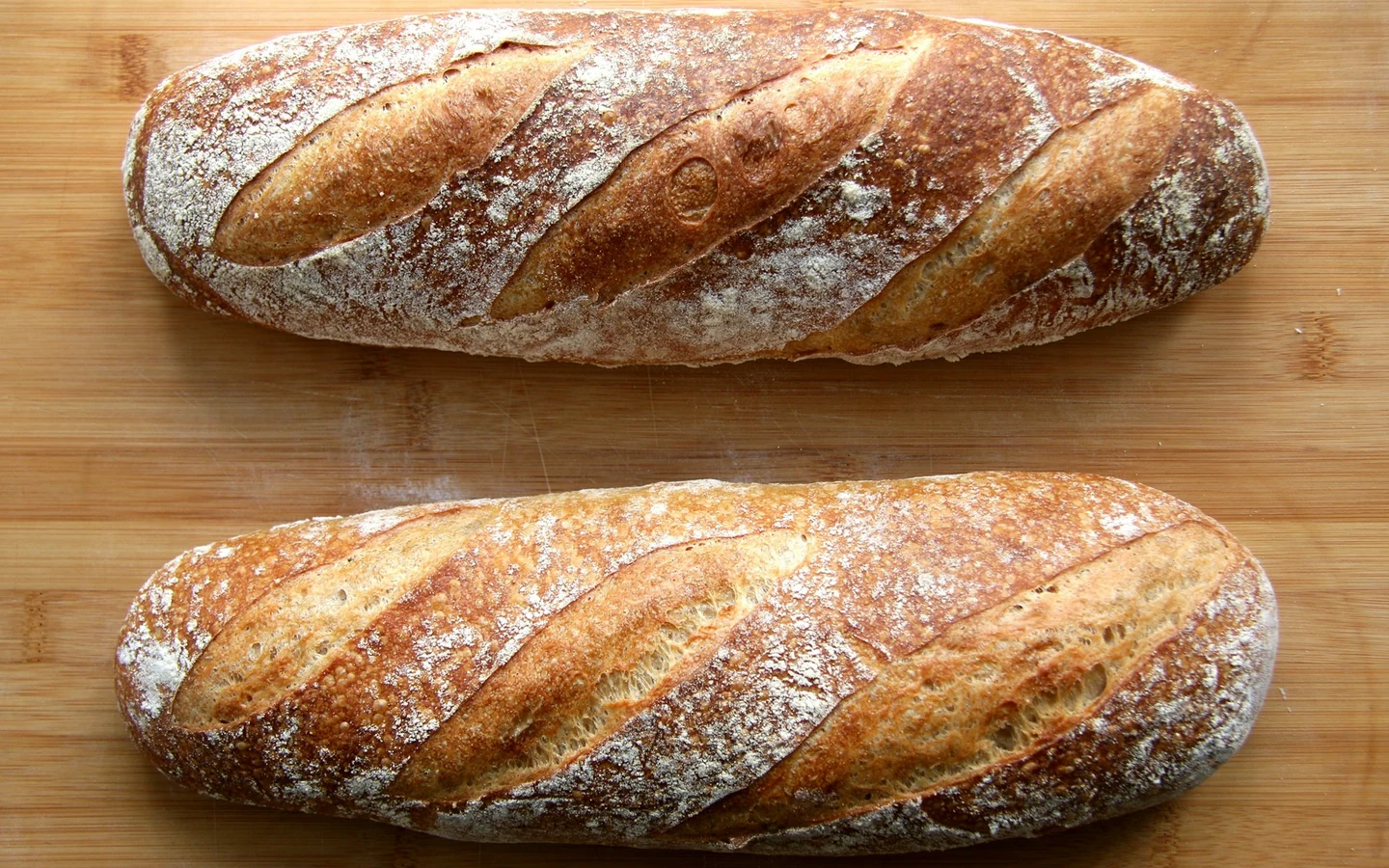
The traditional format is tall, described as accavallata, with a fold along its sides known locally as baciatura and the loaf itself as U sckuanete. A second format is lower, without that fold, and carries the local name a cappidde de prevete, the priest's hat. Crust thickness must be at least 3 millimetres. The crumb must be straw yellow with even alveolation. Size must not fall below half a kilogram. In the text filed in 2003, moisture must not exceed 33 per cent.
A modification proposal published in 2008 would add a ring-shaped format to the permitted list and replace the fixed moisture ceiling with moisture varying according to loaf size, while leaving the varieties, the 80 per cent floor, the milling parameters, the dough ratios, and the resting times as they were. A further temporary amendment to the specification was decreed by the Italian agriculture ministry in February 2025; the decree's existence is a matter of public record, though its operative text is not reproduced here.
Why the boundary is drawn where it is
The designated area is not one town. It covers five municipalities in the province of Bari: Altamura, Gravina di Puglia, Poggiorsini, Spinazzola and Minervino Murge, defined in the filing against numbered 1:25,000 map sheets. The same territory supplies the wheat, the mills, and the bakeries.
The filing grounds this in agronomy and in continuity of practice rather than in sentiment. It describes the technique as having settled in this territory over centuries, traces the loaf's origin to Altamura in the 1500s, and notes that in its most traditional and notably large form the dough was mixed and handled at home before being taken to an oven for final shaping and baking. The claimed link to place rests on durum wheat grown under the specific geographic and environmental conditions of the north-western Murgia, plus ordinary local drinking water.
What a specification can and cannot protect
Everything above is enforceable. A baker outside those five municipalities, or using a different variety mix, or milling above 40 degrees, or shortening the first rest to an hour, is making something else and may not use the name.
What the document cannot do is guarantee that any given protected loaf is good. It fixes inputs, ratios, and process windows, which is exactly the part of bread quality that can be verified by inspection. Judgement, the reading of a dough on a particular day, sits outside its reach. That limit is worth keeping in mind whenever a protected name is treated as a quality score rather than as what it is: a description of method, written down precisely enough to be checked.